
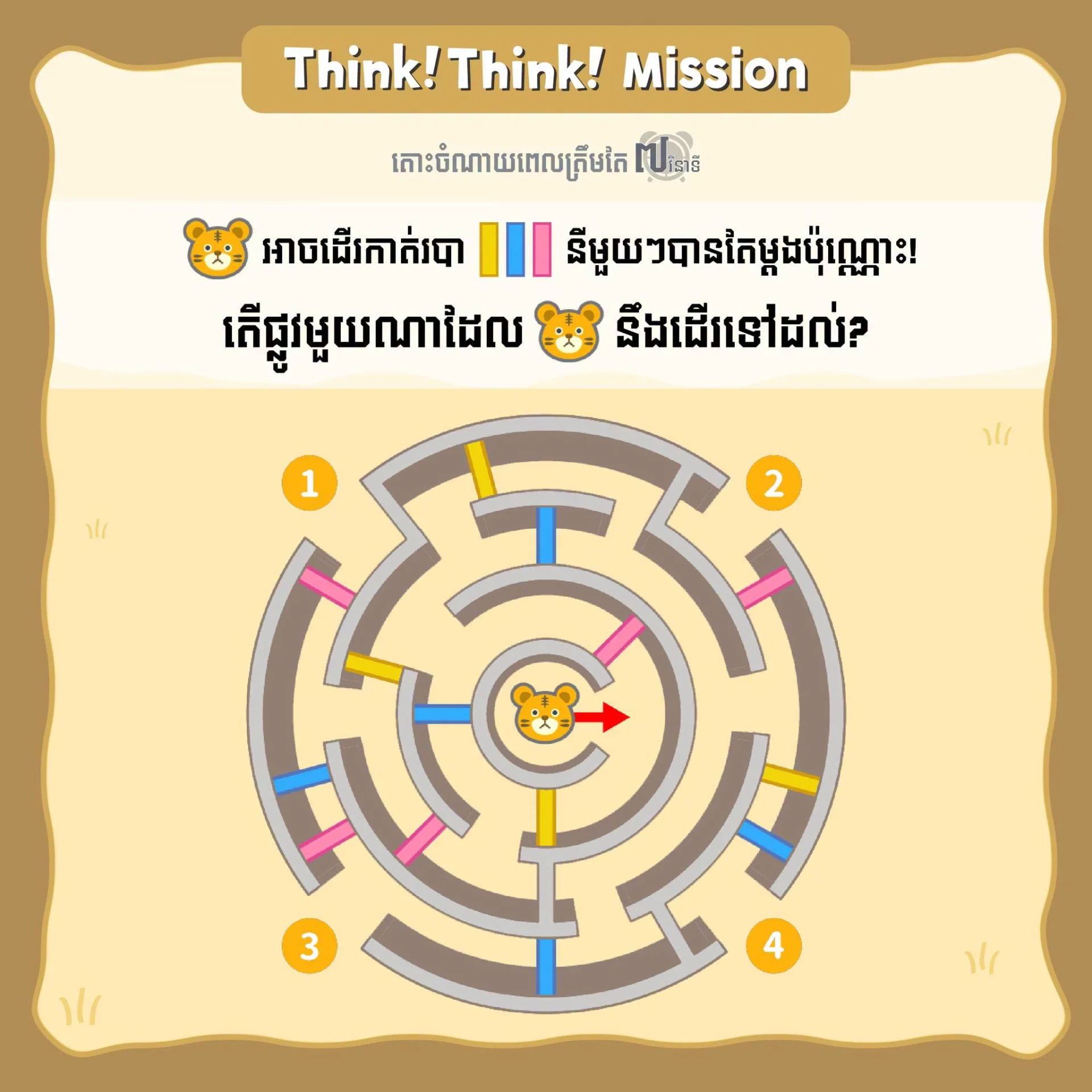

ThinkThink Cambodia has shared a short visual puzzle inviting families and children to solve a maze challenge in just seven seconds. The activity, presented as a “Think! Think! Mission,” asks viewers to help a cartoon tiger find a route through a circular maze and identify which of three coloured goals it can reach.

The Facebook post encourages participants to examine the picture, make a choice and share their answer in the comments. Its brief time limit adds a playful sense of urgency, although children can also benefit from solving the maze at their own pace.
What is the ThinkThink Cambodia maze challenge?
The image shows a tiger near the centre of a circular maze, surrounded by curved walls, openings and coloured route markers. The challenge presents three coloured targets, yellow, blue and red, and asks viewers to work out which goal the tiger can reach.
Rather than following the first apparent opening, participants need to trace possible paths carefully. A route that looks promising may end at a barrier, requiring the solver to reconsider and explore another possibility. The puzzle is therefore a simple example of visual reasoning through play.
The original post describes the challenge as a seven-second activity and invites viewers to leave their answer below the Facebook post. It does not provide assessment results or claim that completing the maze measures a child’s intelligence.
How visual puzzles support problem-solving
Visual mazes give children opportunities to practise observing details, comparing alternatives and planning a sequence of movements. To solve a maze, a child may need to hold a potential route in mind while checking whether walls and openings connect.
These processes draw on attention, visual-spatial reasoning and aspects of executive functioning. Children can also practise cognitive flexibility when they abandon an unsuccessful route and try another. A puzzle becomes especially useful as a learning conversation when an adult asks the child to explain how they reached an answer.
Speed should not be treated as the only measure of success. Some children prefer extra time to inspect a picture, while others benefit from pointing to a path or tracing it with a finger. Allowing these approaches can keep the focus on reasoning rather than performance pressure.
Practical ways parents and teachers can use the activity
Parents can begin by showing the maze without a countdown. Ask the child to locate the tiger, name the three colours and predict which route might work. Then invite the child to follow a possible path from the centre toward the outside.
If the path stops, encourage the child to describe what happened and try another direction. Adults can model phrases such as “This opening leads to a wall” or “Let’s check another route,” while leaving the final decision to the learner.
Teachers can use a similar image as a brief classroom warm-up. Children may work independently before comparing their reasoning with a partner. For younger learners, enlarging the picture and offering more time may make the activity easier to access.
Where to learn more about ThinkThink Cambodia
The Facebook post identifies ThinkThink Cambodia and shares its learning lab website. It also lists contact numbers for Toul Kork and Boeung Keng Kang campuses in Phnom Penh. Families seeking information about classes or visiting arrangements should check directly with the organisation.
Activities such as this ThinkThink Cambodia maze challenge can offer a convenient starting point for discussions about planning, checking and revising an answer. The most useful follow-up is often asking children to show their thinking, regardless of how quickly they finish.
If the information about this school is inaccurate or incomplete, Contact Us.
Would you like to register your school? Click Here.



Leave A Comment