
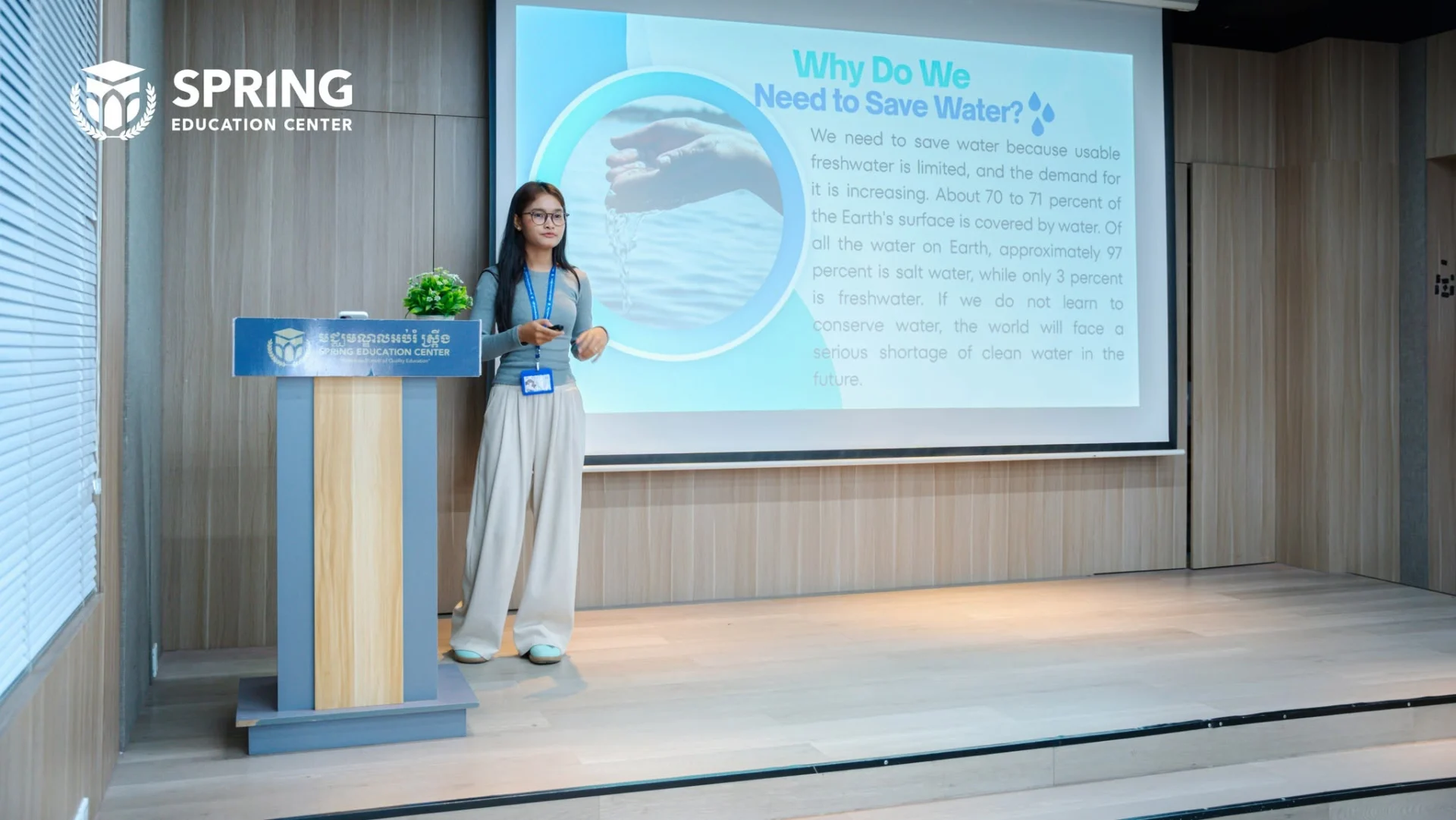

Spring Education Center in Phnom Penh recently shared photographs of students participating in a presentation activity that brought learners together to practise speaking, share ideas and engage with their peers. The images show students presenting in front of an audience, as well as a group photograph marking the occasion.

The school’s Facebook update celebrates the students’ participation and the learning experience. Rather than reporting examination results or a formal competition, the post highlights an opportunity for students to build confidence and demonstrate skills through an organised group activity.
Spring Education Center students practise presentation skills
The photographs show individual students speaking at the front of a room with projected slides behind them. One slide discusses why saving water matters, while another explores the importance of friendship. These examples suggest that students were encouraged to communicate ideas on topics connected to everyday life.
The setting includes a presentation screen, a lectern and an audience. Other photographs show students and staff gathered together at the end of the activity. The school did not provide a complete programme, participant list or detailed assessment criteria in the visible announcement.
For learners studying an additional language, presenting to a group can provide a practical opportunity to organise thoughts, choose appropriate vocabulary and communicate clearly. It also creates a reason to practise pronunciation, pacing and listening beyond routine classroom exercises.
Why student presentations support language learning
Preparing a short presentation requires several connected skills. Students must understand their topic, select useful information, decide how to structure their message and consider what their audience needs to know. Rehearsal can help them become more familiar with the language and improve their delivery.
Speaking in front of others can initially feel challenging. A supportive environment, manageable speaking tasks and constructive feedback may help students become more comfortable sharing their ideas. Confidence develops through repeated opportunities to practise, rather than through a single performance.
Presentations also create opportunities for active listening. Audience members can learn to follow an explanation, identify important points and ask relevant questions. Teachers may use these activities to observe communication skills and identify areas where individual learners need additional guidance.
Connecting communication with everyday topics
The topics visible in Spring Education Center’s photographs offer examples of how language practice can be connected to familiar experiences. Discussing water conservation allows students to explain reasons, consequences and possible actions. Talking about friendship gives them a chance to describe relationships, cooperation and supportive behaviour.
These subjects can encourage learners to move beyond memorised sentences and express their own understanding. Teachers can adjust the complexity of the task according to students’ language levels, from describing simple ideas to presenting arguments supported by examples.
Parents can reinforce similar skills at home by asking children to explain something they have learned, describe a process or give a short account of a topic they enjoy. Listening patiently and asking clear follow-up questions can make speaking practice feel purposeful.
What families can learn from classroom activities
When considering a language programme, families may wish to ask how often students have opportunities to speak independently, how teachers provide feedback and whether classroom activities include both prepared presentations and spontaneous conversation.
It is also useful to ask how speaking activities are adapted for beginners or students who are reluctant to address a group. A well-planned approach gives learners opportunities to participate without requiring everyone to perform at the same level.
Spring Education Center’s student presentation activity offers a glimpse of practical communication learning in Phnom Penh. The photographs and announcement show students sharing ideas and participating in a group learning experience, with presentation practice forming part of the occasion.
If the information about this school is inaccurate or incomplete, Contact Us.
Would you like to register your school? Click Here.
Leave A Comment