
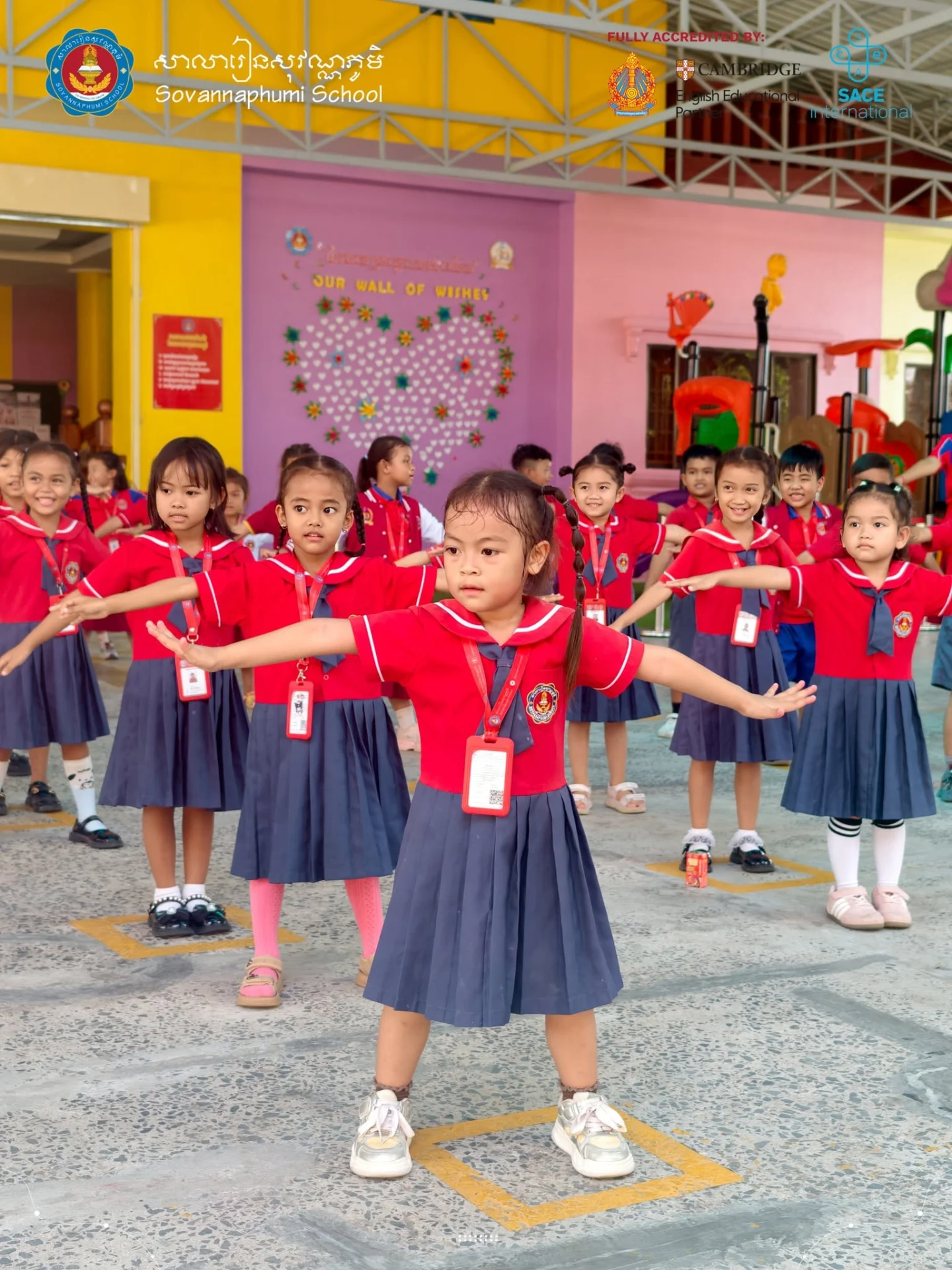

Sovannaphumi School, Svay Rieng II Campus, has shared a classroom activity in which students from its General English Program (GEP) enjoyed singing and dancing together. The school says that combining music with movement helps children build confidence, express creativity and practise social skills while enjoying their learning experience.
Sovannaphumi School Svay Rieng II Campus brings music into learning

The school’s Facebook post describes GEP students taking part in a group singing and dancing activity. Photographs show an adult leading children and several students participating together. The announcement focuses on the enjoyment of learning through music, movement and shared experiences.
Music-based classroom activities can provide a different way for children to engage with language and classmates. Songs introduce patterns of sound and rhythm, while coordinated movements invite students to listen, watch and respond. Such activities can complement other classroom teaching when selected to match learners’ ages and abilities.
The post does not identify a particular song, lesson objective or student age group. It also does not report measured improvements in language or confidence. The school’s comments describe its intended educational benefits rather than formal assessment findings.
Singing, rhythm and English-language participation
For children studying English, songs can offer repeated exposure to familiar words, phrases and pronunciation patterns. Repetition may make it easier to practise language without requiring every student to speak alone in front of the class.
Teachers may use actions alongside lyrics to connect spoken language with meaning. For example, movement songs can reinforce action words and simple instructions. Group activities can also give students opportunities to notice when to begin, pause or follow a changing rhythm.
These are general examples of music-supported language teaching, not a confirmed description of the specific song used at Sovannaphumi School. Learning outcomes depend on the content, instruction and individual student’s needs.
Confidence and creativity through movement
Sovannaphumi School identifies confidence and creativity as two benefits of its singing and dancing activity. Group performance can offer children a supportive setting to try unfamiliar actions, express themselves and become more comfortable participating with others.
Movement also creates opportunities to coordinate the body with sound. Students may practise balance, timing and awareness of personal space as they follow an activity. Educators can vary the pace or offer seated movements so children with different physical abilities can participate.
Confidence develops at different rates. Some children readily join group activities, while others prefer to observe before participating. Allowing gradual involvement and avoiding pressure can help make the experience more inclusive.
Developing social skills in group activities
Singing and dancing together can encourage students to pay attention to peers, share space and cooperate with a group. Children may practise taking turns, responding to cues and celebrating one another’s participation.
Teachers can support these skills by demonstrating actions clearly, explaining expectations and acknowledging effort. For younger learners, predictable routines and visual demonstrations may make participation easier.
Parents can use simple songs at home to extend opportunities for shared play and communication. Familiar music, gentle movement and opportunities for children to choose an action can make the experience accessible without special equipment.
Learning experiences at the Svay Rieng II Campus
The Facebook announcement illustrates one activity offered to GEP students at Sovannaphumi School, Svay Rieng II Campus. Families interested in the program can contact the campus at 015 838 926 to ask about enrolment, class schedules and how music-based activities fit into the wider curriculum.
Through this group singing and dancing session, Sovannaphumi School Svay Rieng II Campus presents learning as an experience that can involve language, movement, creativity and social interaction. The post provides a specific example of student participation in its General English Program.
If the information about this school is inaccurate or incomplete, Contact Us.
Would you like to register your school? Click Here.
Leave A Comment