
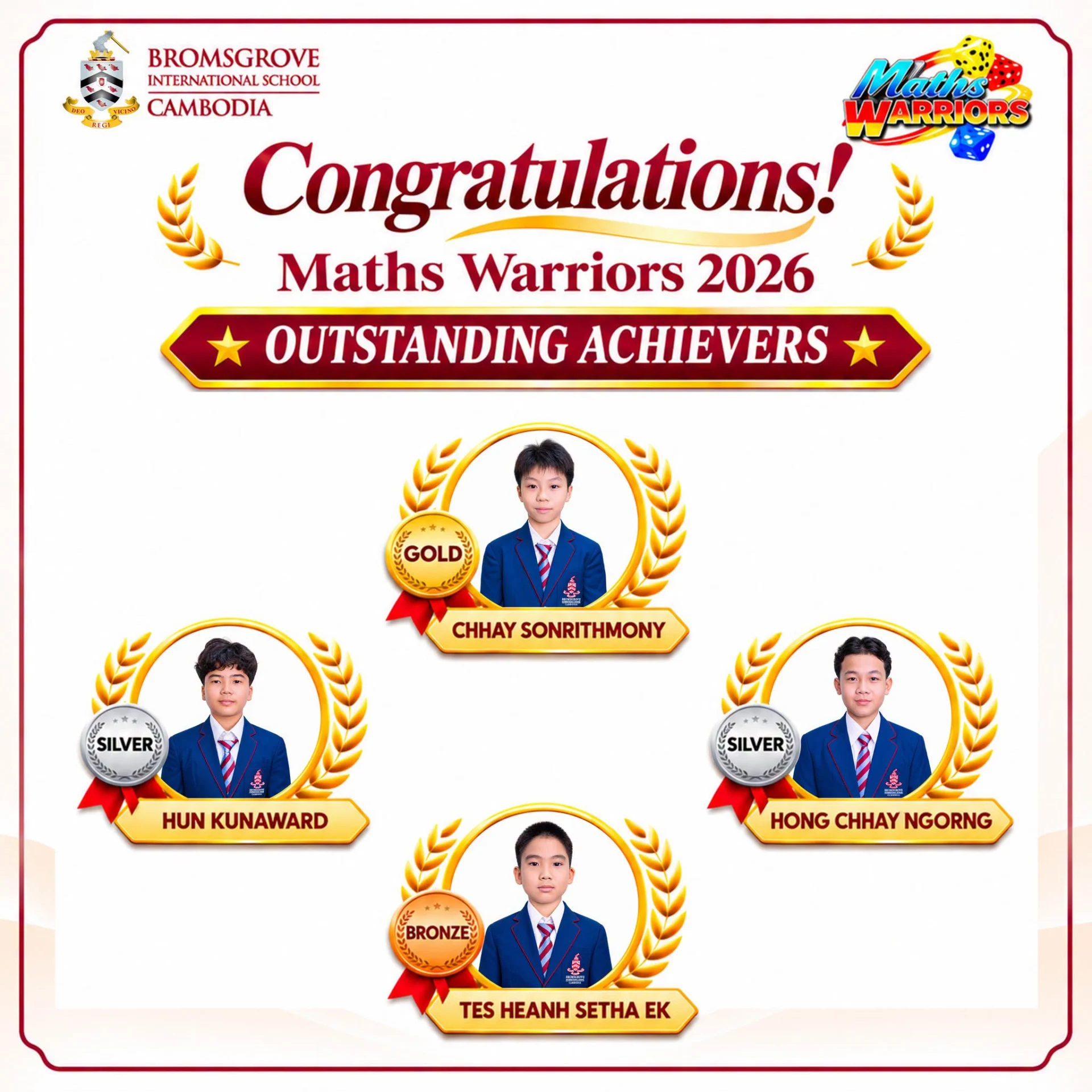

Bromsgrove International School Cambodia reported that its students earned four medals at Maths Warriors 2026. The school announced one gold, two silver and one bronze in a Facebook post congratulating the students on their mathematical problem-solving and persistence. The post included a graphic with student portraits and gold, silver and bronze medal labels.
Maths Warriors 2026 results for Bromsgrove Cambodia

The school’s graphic names Chhay Sonrithmony as the gold medallist. Hun Kunaward and Hong Chhay Ngorng appear alongside the two silver medals. The school also reported a bronze medal, though the bronze medallist’s name falls below the visible edge of the announcement image.
The medal count comes from the school’s announcement. The post did not specify the students’ year groups, how the competition was scored or what kinds of problems they solved. The school’s education page lists competitions under enrichment. It gives families a starting point for asking how students learn about opportunities to enter.
What students can practise before a maths competition
One way to prepare for a problem-solving competition is to choose a question that allows more than one method. For example, ask students how many rectangles they can make using exactly 24 identical squares, with no gaps. A student might draw the arrangements first, while another might list pairs of whole numbers that multiply to 24. They can then compare their lists and decide whether a rectangle turned sideways counts as the same shape.
The next step is to explain how they know they have found every possibility. A student might organise the list by the shorter side and stop once the next pair repeats an earlier rectangle in reverse. That explanation is worth discussing even if everyone in the group arrived at the same answer. It shows where the method comes from and helps students see whether they could use it with a different number of squares.
How teachers and families can support maths practice
Teachers can build in a few minutes for students to compare solutions before sharing an answer. If one student uses a drawing and another makes a table, the class can identify where each method makes the same information visible. A short discussion about which method is easier to check can help students choose an approach for the next problem. The rectangle activity is an example for practice. The school’s announcement did not include competition questions.
At home, a family can try a similar approach with a puzzle or a practical question, such as working out how many ways to share a set of objects into equal groups. Give the child time to try an idea. If they get stuck, ask what they already know or whether a smaller example would help. Once they have a solution, invite them to show how they checked it.
Families interested in events such as Maths Warriors 2026 can ask their school how it shares competition opportunities, which year groups can take part and what preparation is expected. They can also ask for examples of problems a child can try before deciding whether to enter. Bromsgrove’s announcement records four medal results, and the school’s enrichment page offers a route for families who want to ask about future opportunities.
If the information about this school is inaccurate or incomplete, Contact Us.
Would you like to register your school? Click Here.

Leave A Comment