
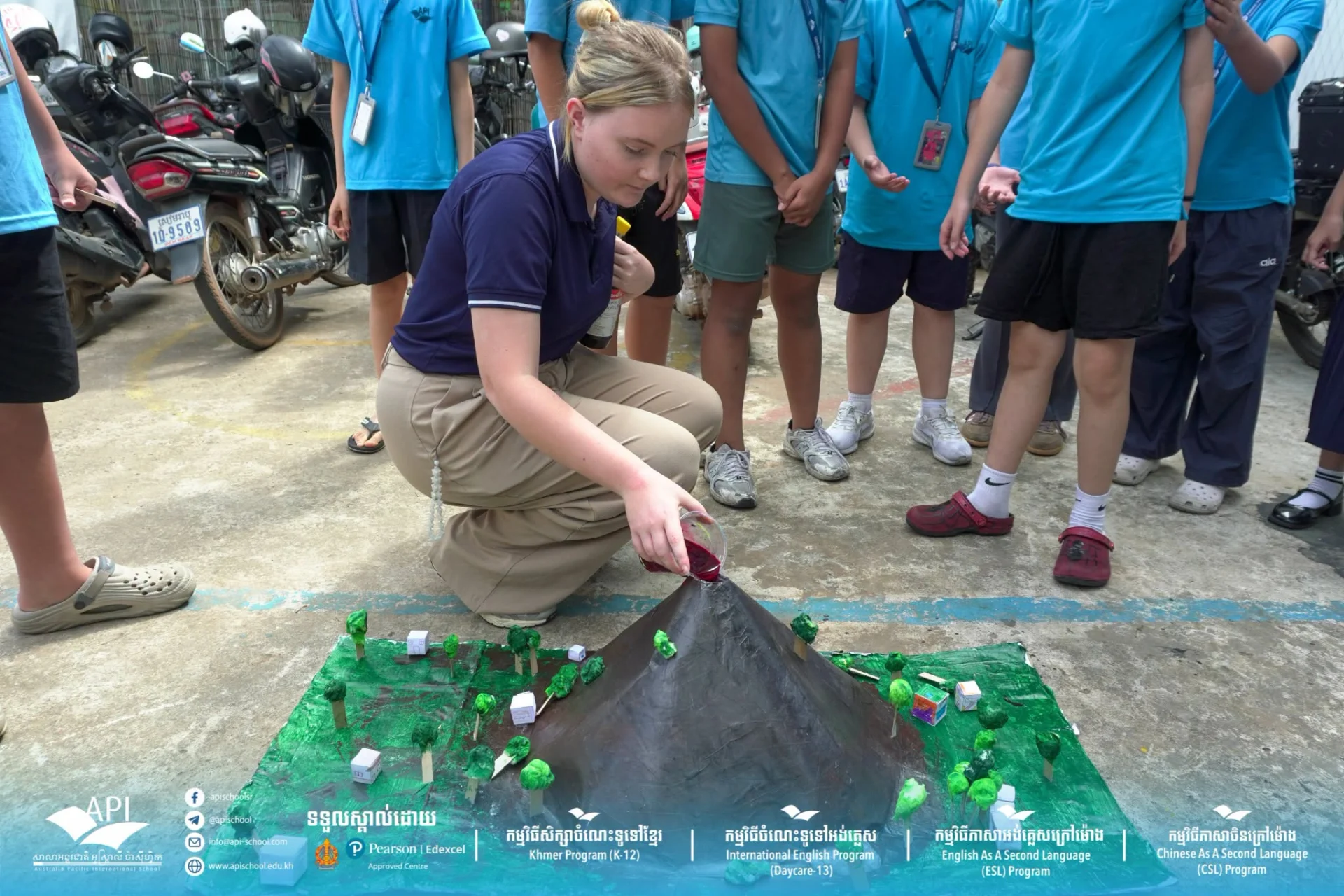
API-School students in Siem Reap have taken part in a volcano eruption experiment designed to make science more tangible. In a Facebook update, the school described the hands-on activity as an opportunity for students to explore chemical reactions and earth science while practising critical thinking and teamwork. The post identifies Grade 6 learning and shows students gathered around a model volcano.
API-School volcano experiment introduces scientific concepts

A model volcano offers a visual starting point for discussing what happens when substances interact. In a typical classroom demonstration, an acid and a base react to release carbon dioxide gas, which pushes foam or liquid out of an opening. The school’s post does not identify the materials used, so the exact reaction in its demonstration cannot be confirmed.
The important learning opportunity comes from looking beyond the eruption itself. Teachers can ask students to identify the materials, predict the outcome, observe changes and explain what evidence supports their conclusions. These steps introduce scientific reasoning in a way that students can see and discuss.
The activity also provides a useful distinction between a chemical reaction in a model and an actual volcanic eruption. Real volcanoes involve molten rock, dissolved gases, pressure and geological processes. A classroom foam eruption is an analogy that helps students picture an erupting volcano; it does not reproduce the geological mechanism.
How hands-on science supports Grade 6 learning
Practical science activities can help students connect classroom vocabulary with observable events. Instead of memorising a definition of a reaction, learners can describe what changed, when it changed and what might have caused it.
For Grade 6 students, an activity like this can support several skills. Predicting an outcome encourages learners to apply prior knowledge. Recording observations helps them separate what they saw from what they assume. Comparing predictions with results introduces the idea that explanations must respond to evidence.
Teamwork can also be taught explicitly during experiments. Students may share materials, take turns recording observations and discuss competing explanations. These are possible teaching approaches, rather than confirmed details of how API-School organised its particular activity.
Teachers can extend such lessons with short written reflections or science vocabulary exercises. Where English is used in the classroom, students may practise terms such as reaction, gas, pressure, evidence and eruption alongside the scientific concepts.
What parents can ask after a volcano experiment
Parents do not need specialist equipment to discuss the learning at home. Asking a child to explain the experiment in their own words can reveal which ideas they understood and which still need clarification.
Useful questions include what the student expected to happen, what actually happened and why the model behaves differently from a real volcano. Encouraging children to distinguish observation from explanation supports careful thinking.
Families should avoid attempting chemical demonstrations without suitable adult supervision and clear safety instructions. Questions, diagrams, reading and discussion can reinforce the learning without repeating the experiment.
About API-School in Siem Reap
API-School lists its address as Street 27, Wat Bo Village, Sangkat Sala Komreuk, Siem Reap Municipality, Cambodia. Its Facebook post provides contact numbers 095 070 061 and 069 617 373, along with the school’s website for information about its programs.
The Facebook update does not specify the experiment’s exact date, the number of participants or any measured learning outcomes. Those details should not be inferred from photographs alone.
For families exploring science education in Siem Reap, the API-School volcano experiment offers an example of how a school can introduce scientific questions through a shared practical activity.
If the information about this school is inaccurate or incomplete, Contact Us.
Would you like to register your school? Click Here.
Leave A Comment