
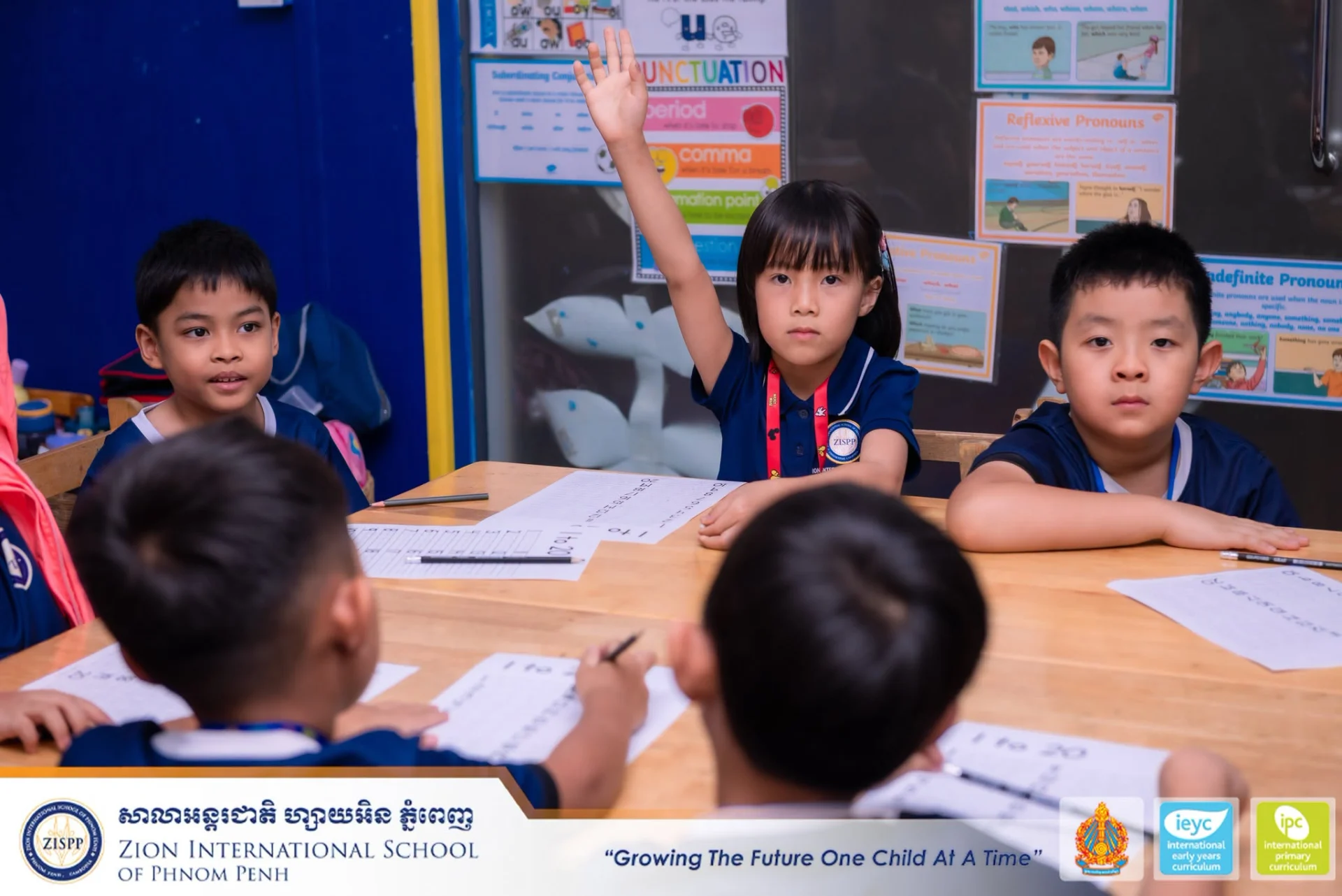

Zion International School of Phnom Penh has shared how its Grade 1 students are developing early mathematics skills through interactive activities, games and guided practice. According to the school’s Facebook post, the lessons focus on recognising, counting and writing numbers from 1 to 20. The school describes these activities as part of building children’s confidence and a positive attitude towards mathematics.
Zion International School of Phnom Penh Grade 1 mathematics lessons

The school’s announcement identifies three areas of learning: recalling and recognising numbers, identifying numbers confidently and writing numerals with correct formation. These are related skills, but each requires different kinds of practice. A child may recognise a printed number before being able to write it independently or connect it consistently with a quantity.
Interactive games and teacher-guided activities can provide different ways to practise these foundations. Children may respond verbally, point to a numeral, count objects or attempt to write a number. The Facebook post does not specify the exact games used or provide assessment results, so individual progress should not be assumed.
The school also highlights enjoyment and confidence. For children beginning formal mathematics, opportunities to participate without excessive pressure can help them become more willing to attempt unfamiliar tasks and ask for clarification.
Learning numbers from 1 to 20
Recognising numerals is an important early skill, but understanding what numbers represent is equally useful. Teachers can connect written symbols with groups of objects so that children see how the numeral five, for example, relates to five counters or five classroom items.
Counting involves more than reciting a sequence. Children gradually learn to match one counting word to each object and understand that the final number spoken represents the total quantity. These concepts can be reinforced through practical tasks involving familiar materials.
Writing numerals introduces a further demand: controlling a pencil and remembering how each symbol is formed. Some learners may need demonstrations, tracing or additional time before writing independently. Variation in the pace of these skills is common, and teachers can adjust practice to suit each learner.
Why hands-on mathematics activities are useful
Early mathematics activities can make abstract ideas more concrete. Moving counters, arranging number cards and comparing small collections give children visible examples of quantity and order. Teachers can then connect those experiences to spoken number words and written numerals.
Games may also provide opportunities for turn-taking, listening and explaining answers. A teacher can observe whether a child counts carefully, skips objects or relies on memorised sequences. Such observations help identify what needs further teaching, although a classroom game alone is not a formal assessment.
Guided practice is especially valuable when feedback is specific. Instead of simply telling a child an answer is incorrect, an adult can demonstrate a counting strategy and invite the child to try again.
How parents can support early numeracy at home
Parents can reinforce numbers from 1 to 20 during everyday routines. Counting steps, sorting toys or matching written numerals to small groups of objects offers short opportunities for practice without requiring specialised equipment.
Children can also look for numbers on calendars, books and household items. Adults can ask how many objects are present and encourage children to check by counting each one. Keeping activities brief and responsive to the child’s interest helps maintain engagement.
Zion International School of Phnom Penh’s Grade 1 mathematics announcement describes an approach combining number recognition, counting and numeral writing with active participation. These early experiences can provide a foundation for more advanced mathematical learning as children develop accuracy and confidence.
If the information about this school is inaccurate or incomplete, Contact Us.
Would you like to register your school? Click Here.
Leave A Comment