
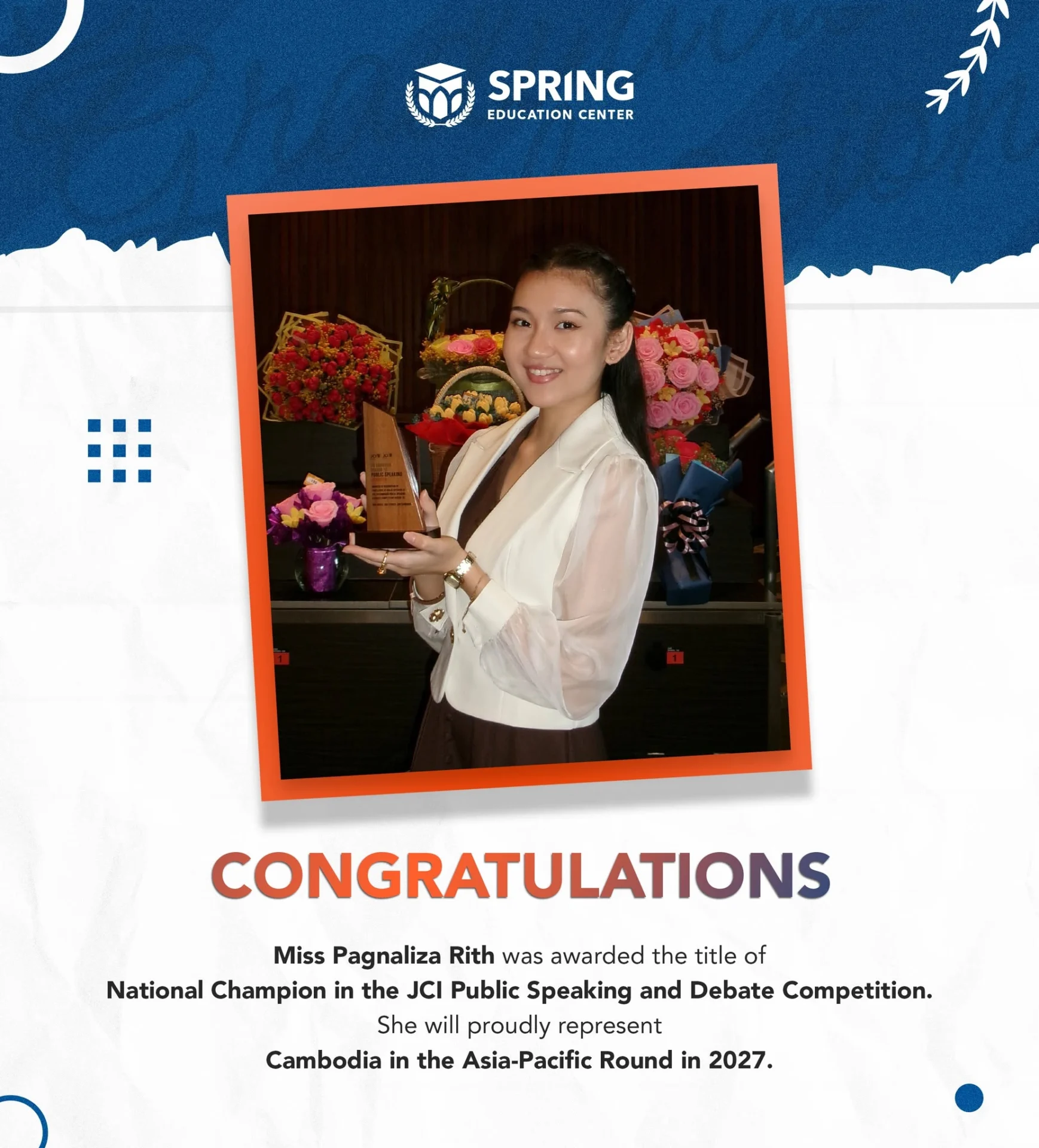

Rith Pagnaliza won the national public speaking title at the JCI Cambodia National Public Speaking & Debate Competition. In a Facebook announcement, Spring Education Center congratulated Pagnaliza, a former coach of its Spring IELTS Club, and said she will represent Cambodia in the Asia-Pacific Round in 2027. The announcement connects a former club coach with an achievement that offers language learners a concrete example of how a speaker can develop a clear argument for an audience. Spring Education Center on Facebook
Rith Pagnaliza’s national title and next round

The American University of Phnom Penh (AUPP) identified Pagnaliza as one of its students and confirmed that she won the public speaking division. The university also reported separate results for the debate division. Pagnaliza’s speech explored which human qualities matter in an age of artificial intelligence. AUPP said the national winners would represent Cambodia in Taiwan in 2027. AUPP’s competition announcement
That distinction between the divisions is useful for students choosing an activity. In a prepared speech, a speaker guides listeners through a central idea, supports it with examples and brings the talk to a clear close. Debate adds the task of listening to another side and responding to its claims. Schools can teach both skills with the same topic by asking students to deliver a short speech first, then respond to a classmate who takes a different position.
How language learners can practise public speaking
Students can start with a one-minute talk on a familiar subject. A prompt such as “Which change would make our school day easier?” gives the speaker a specific audience and a reason to make a case. A simple outline can fit on an index card: state the proposed change, give one example of the problem, and explain what the change would do.
After the talk, listeners can write down the main point in one sentence. If their answers differ, the speaker can revise the opening or explain the example more clearly. Students learning English can rehearse in pairs before speaking to a group. Teachers can give feedback on one feature at a time, such as whether the speaker pauses after the main point or explains a term that classmates may find unfamiliar.
A second attempt gives students a chance to put that feedback into practice. They can deliver the same talk with a clearer opening or a more specific example, then ask listeners what they understood this time. Recording both attempts can help students hear where they speak too quickly or leave out information their audience needs.
What families can look for in a speaking club
Families comparing public speaking or language clubs can ask how often each learner gets to speak, how instructors give feedback and whether beginners can rehearse in small groups. It also helps to ask whether the club focuses on prepared speeches, debate, exam speaking or a mixture. Each format gives learners a different kind of practice, so the right choice depends on what the student wants to improve.
As Rith Pagnaliza prepares to represent Cambodia in 2027, teachers can use her speech topic as a classroom prompt. Ask students to choose one human skill they think matters when people use AI, explain it through an example from school or daily life, and give classmates a chance to question their reasoning. The exercise gives students practice explaining an idea and responding to an audience.
If the information about this school is inaccurate or incomplete, Contact Us.
Would you like to register your school? Click Here.


Leave A Comment