
Happy Daycare Phnom Penh Cambodia recently shared a hands-on science activity in which young children explored the properties of flour, water and colours. The activity encouraged children to observe changes in materials, experiment with textures and learn through direct participation.

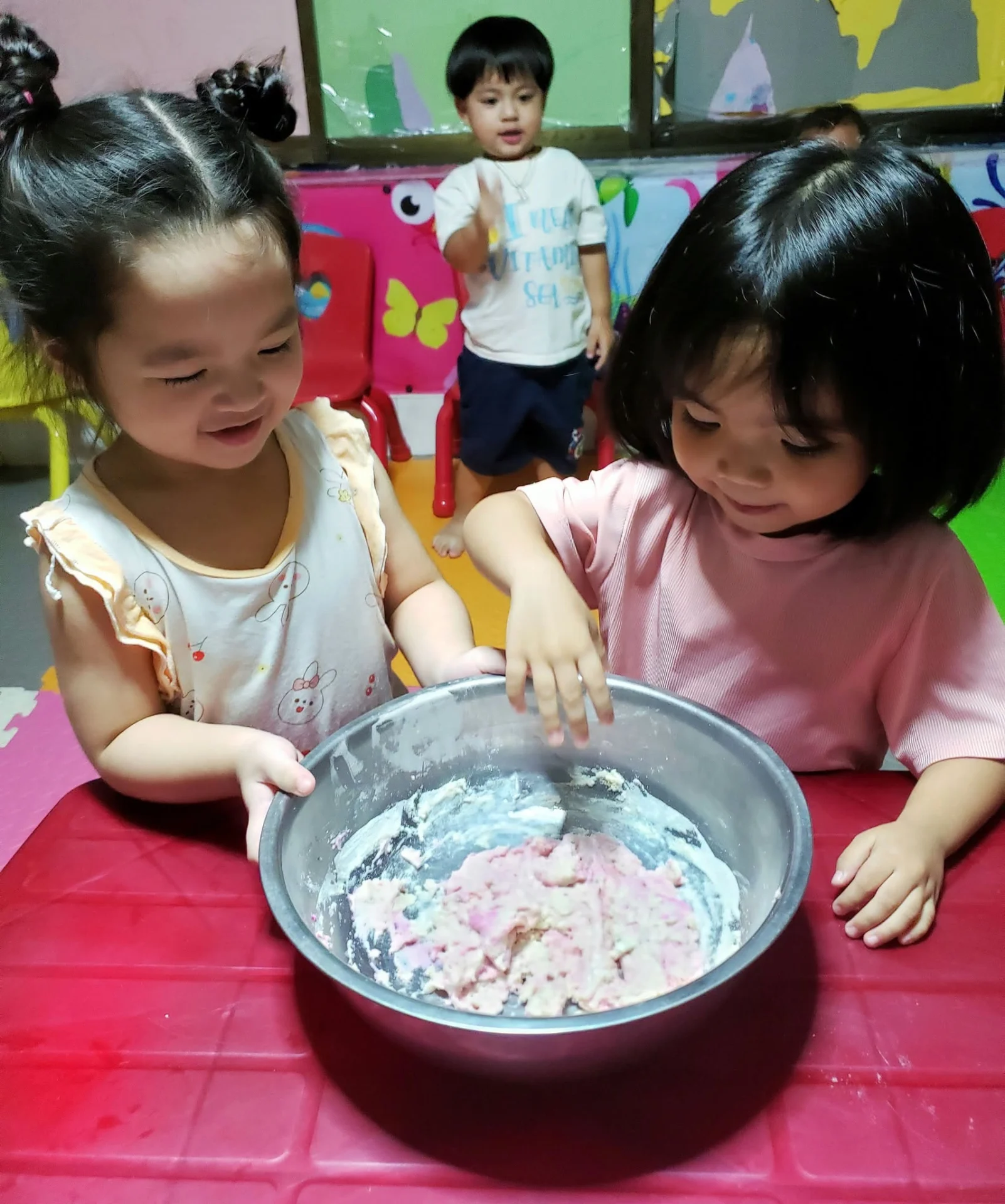
Photographs accompanying the daycare’s announcement show children gathered around a mixing bowl containing a flour-based mixture with pink colouring. The experience provided an introduction to scientific exploration using familiar materials.
Exploring science through sensory play
According to Happy Daycare, the activity allowed children to observe how flour changes when mixed with water, explore colours and textures, and practise using their hands to manipulate the mixture.
For young children, early science education can begin with simple observations. Mixing dry and wet ingredients provides an opportunity to notice differences in consistency and appearance. Children can explore how a powder becomes a softer mixture and how adding colour changes what they see.
These experiences can encourage curiosity without requiring children to understand formal scientific terminology. Adults can introduce simple descriptive words and encourage children to communicate what they notice.
Supporting fine motor development
Happy Daycare also identified hand skills as a focus of the activity. Manipulating soft materials can give children opportunities to practise squeezing, pressing and moving their fingers in different ways.
Fine motor skills are involved in everyday childhood activities such as using utensils, handling small objects, dressing and eventually writing. Play involving suitable materials can provide additional opportunities to practise these movements at an age-appropriate level.
Children differ in their willingness to touch unfamiliar textures. Adults can offer alternative ways to participate, such as using a spoon, observing others or gradually exploring the mixture, without requiring every child to touch it directly.
Encouraging observation and language development
Sensory activities can also create opportunities for conversations between children and educators. Questions about whether a material feels wet, dry, soft or sticky can help children connect vocabulary with their immediate experiences.
Adults can encourage children to predict what might happen when water or colour is added and compare the mixture before and after a change. These simple exchanges introduce elements of scientific thinking, including observation, prediction and comparison.
When children participate alongside their peers, shared materials can also provide opportunities to practise taking turns and communicating their preferences.
Learning through play in early childhood education
Happy Daycare’s announcement emphasised that learning extends beyond reading and listening. Practical activities allow young children to investigate materials directly and develop ideas through experimentation.
For families considering daycare in Phnom Penh, sensory activities are one aspect of an early childhood programme worth discussing. Parents can ask educators how activities are adapted to different developmental levels, how materials are selected and how children are supervised during messy play.
Appropriate hygiene, awareness of food allergies and close adult supervision are important when using flour-based mixtures with young children. Raw flour mixtures should not be eaten.
The activity at Happy Daycare provides an example of how familiar materials can be incorporated into early science and creative play. The daycare did not specify the exact recipe or age group in its announcement.
For more updates on early childhood programmes and school activities in Cambodia, visit Education Cambodia.
Source: Happy Daycare Phnom Penh Cambodia, official Facebook announcement.
Leave A Comment