
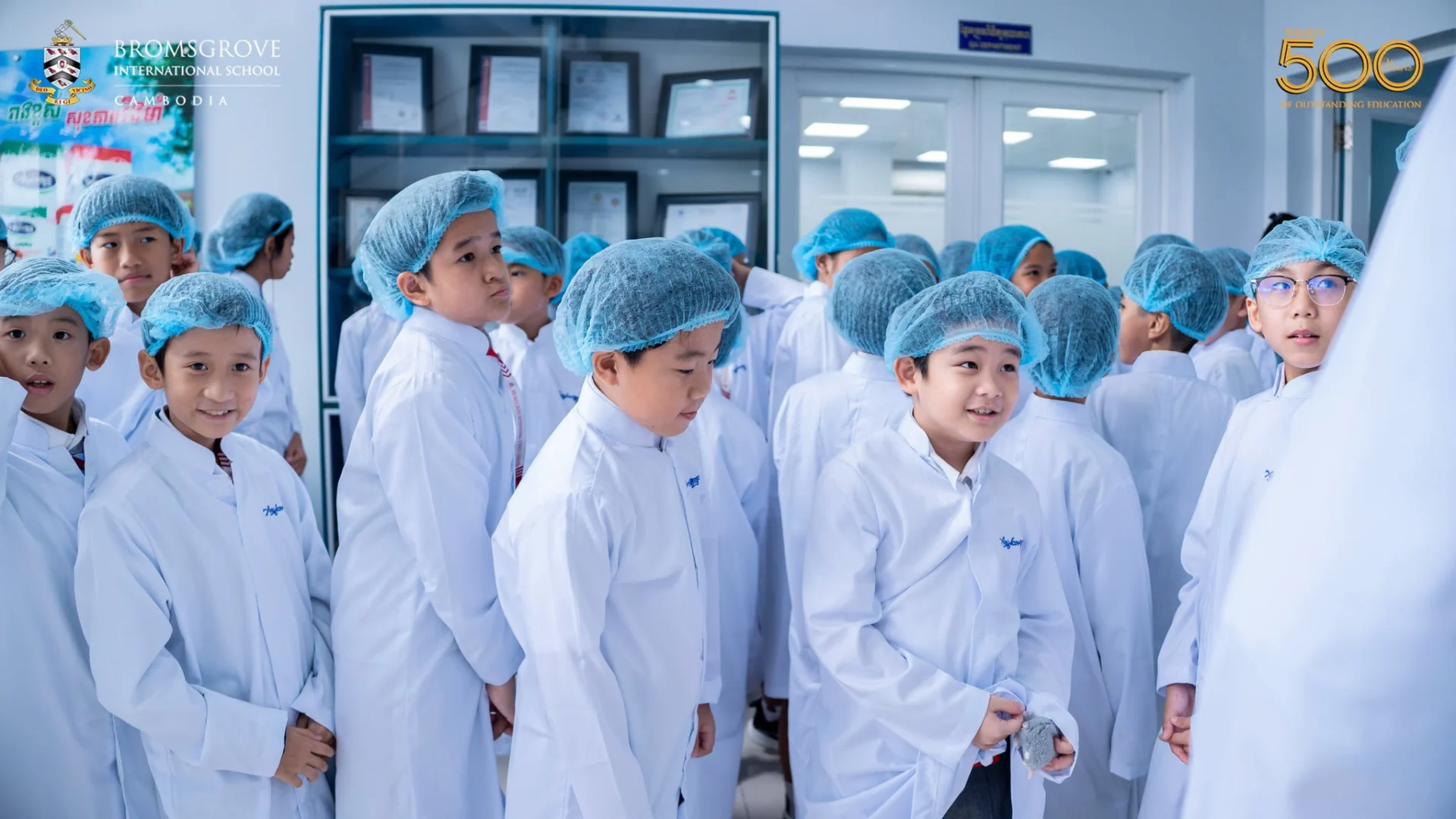
Primary pupils from Bromsgrove International School Cambodia recently visited Angkor Dairy Product Factory as part of an educational field trip. The visit introduced students to a real manufacturing environment and gave them an opportunity to discover how everyday products are made.

In an announcement shared by the school, Bromsgrove described the excursion as an opportunity to develop curiosity and help pupils understand the world beyond their classrooms. Photographs show students wearing protective coats and hair coverings while visiting the facility.
Discovering how everyday products are made
Children regularly encounter dairy products at home, in shops and at school. A factory visit offers a different perspective by introducing them to the environment in which such products are manufactured.
For primary pupils, seeing a production facility can help make abstract ideas about manufacturing more concrete. It can encourage questions about where ingredients come from, how materials are processed and how finished products reach consumers.
The school did not specify which production stages or individual dairy products the pupils observed during their visit.
Connecting classroom learning with real-world experiences
Educational field trips can provide useful contexts for subjects such as science, mathematics and social studies. A dairy factory, for example, can prompt discussions about changes in materials, temperature, measurement and the organisation of work.
Teachers can use these experiences as starting points for subsequent classroom discussions. Students might draw a diagram of a manufacturing process, describe their observations in writing or investigate how products are packaged and transported. These are possible follow-up activities rather than confirmed components of the Bromsgrove visit.
Connecting unfamiliar concepts with everyday products can help pupils understand why classroom knowledge is relevant to their lives.
Introducing pupils to workplace hygiene
Images from the excursion show pupils wearing protective clothing, including hair coverings, inside the factory. This aspect of the visit provides a useful context for introducing children to hygiene requirements in food manufacturing environments.
Young learners can begin to understand why workplaces have different rules from classrooms and why employees and visitors may need to follow specific procedures. Such observations can support discussions about personal responsibility, cleanliness and the importance of following instructions.
The educational value of primary school excursions
Learning outside the classroom gives pupils opportunities to observe unfamiliar environments, ask questions and share discoveries with classmates. These experiences can also encourage communication and cooperation as children participate in activities together.
For families exploring primary education in Cambodia, school excursions are one aspect of a school’s educational approach worth considering. Parents can ask how visits connect with curriculum objectives, how pupils are prepared beforehand and what opportunities they have to reflect on their experiences afterwards.
Effective planning also includes appropriate supervision, accessibility and consideration of individual student needs.
Learning beyond the classroom at Bromsgrove
Bromsgrove International School Cambodia presented the Angkor Dairy Product Factory excursion as part of its approach to practical learning. The visit illustrates how a familiar consumer product can become the starting point for exploring manufacturing and everyday science.
The announcement did not specify the date of the excursion, the number of participating pupils or their individual year groups.
Discover more school activities and educational developments across Cambodia on Education Cambodia.
Source: Bromsgrove International School Cambodia, official Facebook announcement.
Leave A Comment