
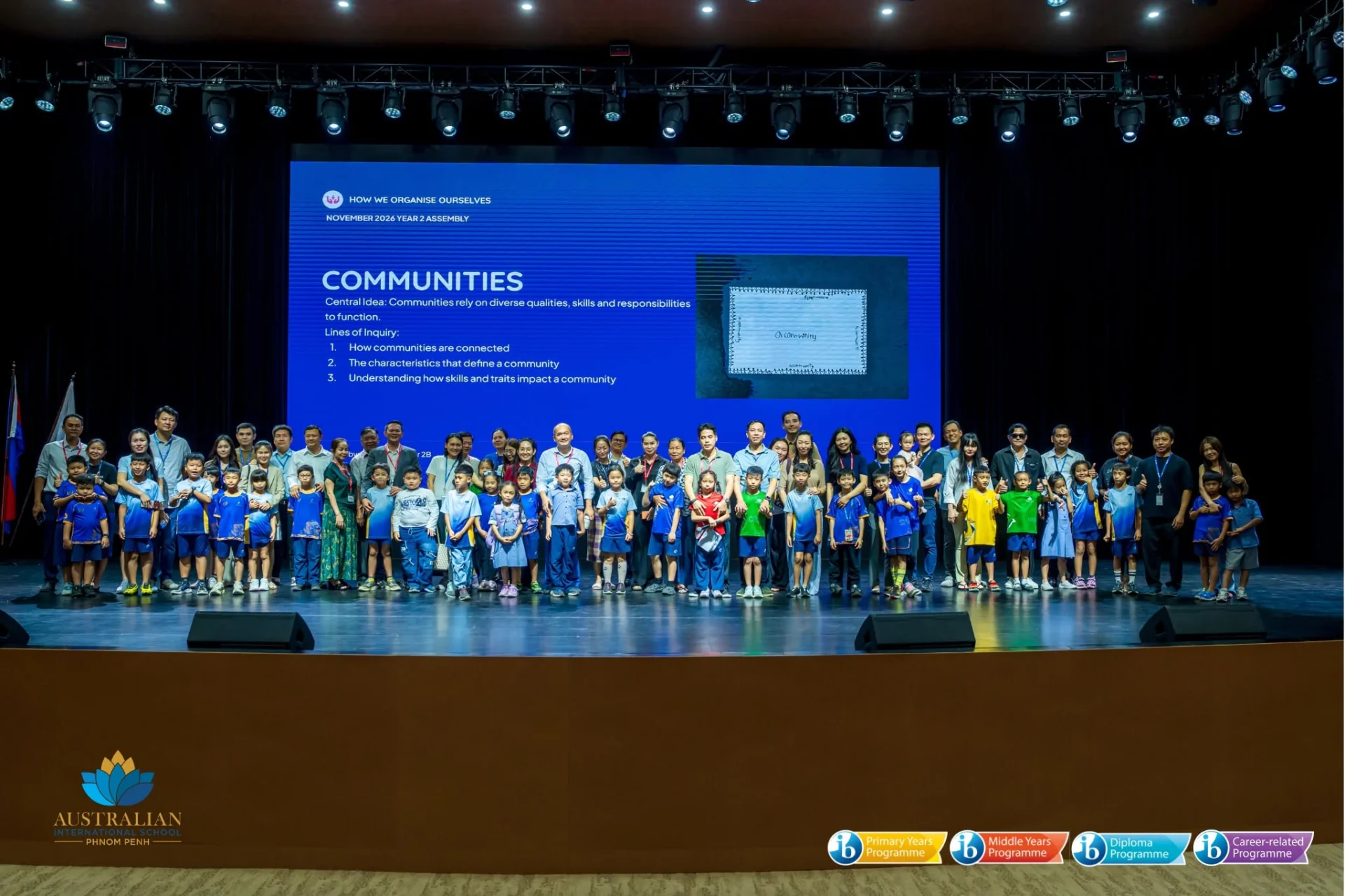
Australian International School Phnom Penh (AISPP) shared highlights from its Year 2 assembly, where students presented what they had learned during their “How We Organise Ourselves” unit. The event focused on communities and brought together original dramas, readers theatre performances and research posters about communities around the world.

In its announcement, AISPP described how Year 2 students presented their inquiry to the wider school community. The assembly provided an opportunity for children to communicate their learning through performance, storytelling and visual research.
Year 2 students explore how communities work

The “How We Organise Ourselves” unit examined communities and the ways people contribute to them. The school’s post highlighted students’ exploration of how communities rely on different skills, care and teamwork.
Research posters about communities around the world formed part of the presentation. These posters offered students a format for organising information and sharing what they had investigated with an audience.

The school did not list the individual communities featured in the posters or describe the specific research questions students pursued. Its announcement instead emphasised the range of ways students communicated their understanding.
Original dramas and readers theatre performances
AISPP Year 2 students performed original dramas as part of the assembly. Drama allows children to present ideas through dialogue, movement and collaboration, giving an audience a way to follow their understanding of a topic.
Readers theatre was another featured activity. In this format, students communicate a story through spoken reading and expression, connecting literacy practice with an audience-facing presentation.
The school connected the students’ inquiry with two literacy stories, “A Different Pond” and “A Chair for My Mother.” Both titles were identified in AISPP’s announcement as part of the learning experience. The post did not specify which scenes or passages students performed.
Connecting literacy and inquiry learning
By bringing stories into a unit about communities, the Year 2 programme linked reading with questions about relationships, responsibilities and shared support. Students could communicate their interpretations through drama and readers theatre while also presenting information from their inquiry.
This approach gave the assembly several forms of student work to showcase. Spoken performances provided one way to share ideas, while research posters offered a visual presentation of information gathered during the unit.
The photographs accompanying the school’s post show children performing together on stage and a large group of students participating in the assembly. One photograph shows students gathered around props during a performance, while others show groups standing in front of a presentation screen about communities.
Developing communication and collaboration
Preparing a group assembly can involve coordinating roles, listening to classmates and practising how to speak to an audience. AISPP’s announcement placed particular emphasis on students demonstrating how communities rely on different skills, care and teamwork.
The school described the Year 2 students as impressing the wider AISPP community with their performances and research posters. That description reflects the school’s own assessment of the occasion; the announcement did not provide formal evaluation results or individual achievement data.
The assembly offered families and the school community a view of classroom inquiry translated into presentations. It also gave students a shared setting in which to communicate the work completed during the unit.
Australian International School Phnom Penh shares assembly highlights
AISPP published the update with photographs of the Year 2 students’ activities. The images document group participation and performance, complementing the school’s account of the unit’s conclusion.
For families interested in learning more about the school, AISPP invited visitors to its admissions office from Monday to Friday, 8:00 AM to 4:30 PM. The school also listed its Telegram channel for updates: AISPP Telegram Channel.
The Year 2 assembly at Australian International School Phnom Penh brought together research, literacy and performance to conclude the “How We Organise Ourselves” inquiry into communities. The activities described by the school centred on how people use different skills, care and teamwork to support one another.
For corrections or additional information, Contact Us. To register your school, Click Here.
Leave A Comment