
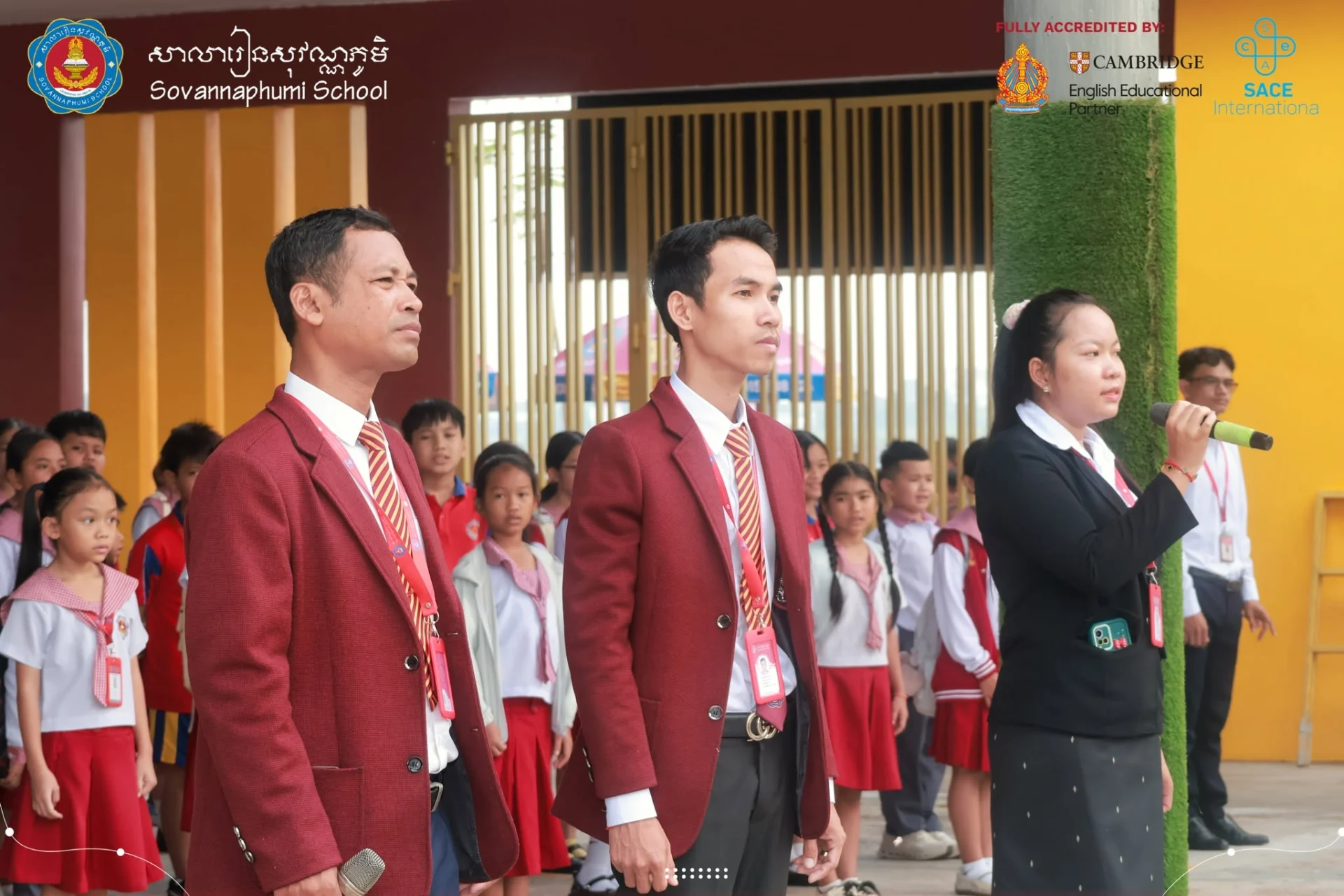

Sovannaphumi School’s Svay Rieng II Campus has shared photographs of students and staff gathering for a school assembly. The images show pupils in uniform standing in organised groups while adults and student representatives address the gathering. The post offers a glimpse of a collective school activity at the campus in Svay Rieng, Cambodia.
Sovannaphumi School Svay Rieng II Campus holds student gathering

The Facebook photo collection shows students assembled in an outdoor covered area and near school buildings. Several photographs feature speakers using microphones, with students listening in rows. Adults wearing formal attire and students in red-and-white uniforms appear throughout the images.
The brief Khmer caption refers to the school and an academic year, but the visible screenshot does not provide enough legible detail to confirm the precise purpose or programme of the gathering. The images alone do not establish whether it was a regular morning assembly, an opening ceremony or another scheduled school event.
No individual speakers are named in the visible material, and the post does not provide an agenda or a record of announcements made during the gathering.
How school assemblies support daily routines
School assemblies are one way for educators to communicate with students as a group. Depending on a school’s programme, assemblies may include reminders, announcements, student presentations or recognition of participation in school activities.
A shared gathering can also help establish a predictable routine. Students learn where to stand, when to listen and how to follow instructions delivered to a larger audience. For younger learners, these expectations often require modelling and regular practice.
The Sovannaphumi School photographs illustrate the organisational side of a group event, with students arranged together and speakers positioned where they can be seen. They do not reveal what students were told or how the school evaluated their participation.
Student communication and participation at school
Speaking in front of peers can provide opportunities to practise clear communication, preparation and confidence. Listening to a presentation, meanwhile, involves attention, understanding spoken information and responding appropriately to group directions.
Schools can make such activities more accessible by using clear language, allowing students time to process instructions and providing suitable support when needed. The approach may differ according to learners’ ages, language backgrounds and individual needs.
For parents, photographs of a school assembly can prompt useful questions about the daily timetable. Families may wish to ask how often assemblies occur, whether students take speaking roles and how teachers support children who find large gatherings difficult.
Creating an organised and inclusive school environment
Group activities are most useful when students understand their purpose and can participate safely. Appropriate supervision, clear movement routes and reasonable expectations for the length of a gathering can help schools manage assemblies involving many pupils.
Teachers may also prepare students in advance by explaining what will happen and reviewing expected behaviour. These measures can be particularly helpful when an event differs from the normal classroom routine.
The images from Svay Rieng II Campus show staff members present during the gathering. However, the screenshot does not provide information about the school’s supervision policies or accessibility arrangements.
Learning more about Sovannaphumi School Svay Rieng II Campus
Families interested in the campus can use the school’s official communications to ask about its academic calendar, classroom programmes and student activities. A single social media post offers only a limited view of daily school life and should not be treated as a complete description of the curriculum.
This Sovannaphumi School Svay Rieng II Campus update documents students and staff taking part in a group gathering. It provides a visual example of school community participation while leaving the exact occasion and programme to be confirmed by the school.
If the information about this school is inaccurate or incomplete, Contact Us.
Would you like to register your school? Click Here.

Leave A Comment