
Zhong Ying International School has shared a classroom update highlighting hands-on science learning through research and practical experiments. Under the theme “Learn to Understand, Experiment to Discover, and Research to Innovate,” the school describes how students explore scientific ideas while developing critical thinking, problem-solving and creativity.

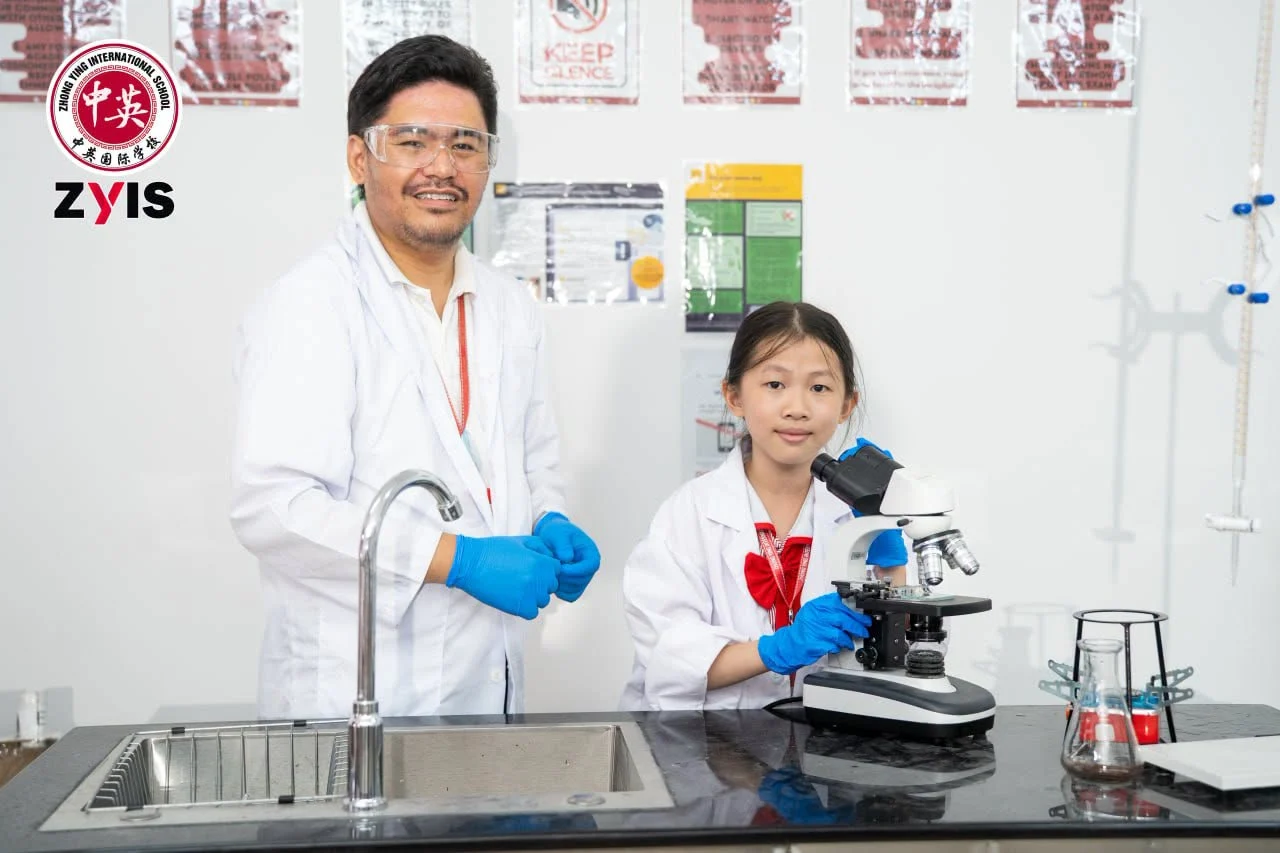
The school’s Facebook post includes photographs of students and an adult in a laboratory setting. Some participants wear white laboratory coats and blue gloves, while equipment visible in the photographs includes a microscope and glassware. The images illustrate practical learning, although the post does not identify the experiments being conducted.
Hands-on science learning at Zhong Ying International School
According to the school’s announcement, students gain learning experiences through research and practical experiments. This approach gives learners opportunities to examine ideas through direct observation and activity, rather than relying entirely on explanations from a textbook.
In science education, hands-on work can help students connect abstract concepts with visible evidence. For example, learners may observe changes, compare results or discuss what an observation suggests. These are examples of general scientific practice, not specific experiments confirmed in the school’s post.
The school did not state the students’ grade levels, the date of the laboratory activity, its duration or any measured learning outcomes. Those details remain unconfirmed.
Developing critical thinking through experiments
Zhong Ying International School identifies critical thinking and problem-solving as important aims of its practical science activities. Both skills are useful when students must consider evidence, question an initial assumption or decide how to investigate a problem.
A scientific investigation often begins with a question. Students then consider what information they need, choose a method and examine what the results mean. Teachers can support this process by asking learners to explain their reasoning and distinguish an observation from an interpretation.
Experiments do not always produce an expected result. When this happens, reviewing the procedure and considering possible explanations can become part of the learning process. A carefully guided discussion can help students understand that scientific knowledge develops through testing and revision.
Research, creativity and scientific curiosity
The school’s theme also connects research with innovation. Research activities can encourage students to seek information, compare possible explanations and communicate their findings. Creativity becomes relevant when learners propose questions or consider different ways to solve a problem.
In a school laboratory, these opportunities depend on the age of students, the equipment available and appropriate supervision. Practical activities should follow clear safety procedures, including suitable handling of materials and equipment.
The Facebook photographs show laboratory coats and gloves, but they do not provide enough information to assess the school’s complete laboratory safety arrangements or the technical content of the activities.
What parents can ask about practical science lessons
Parents interested in science learning can ask how classroom experiments connect with the curriculum and how teachers assess students’ understanding. Useful questions include whether learners record observations, explain results and receive feedback on their reasoning.
Families can also encourage curiosity outside school by discussing everyday phenomena, asking children what they notice and helping them find age-appropriate explanations. Such conversations can reinforce the habit of asking questions without requiring specialised equipment.
For further information about Zhong Ying International School, the Facebook announcement lists telephone contacts including 077 63 5000 and 086 63 5000, along with school Telegram channels.
The Zhong Ying International School hands-on science learning update presents research and practical experiments as opportunities to strengthen students’ curiosity, critical thinking and problem-solving. It offers a glimpse of laboratory-based activities while leaving the specific experiments and learning results undescribed.
If the information about this school is inaccurate or incomplete, Contact Us.
Would you like to register your school? Click Here.
Leave A Comment