
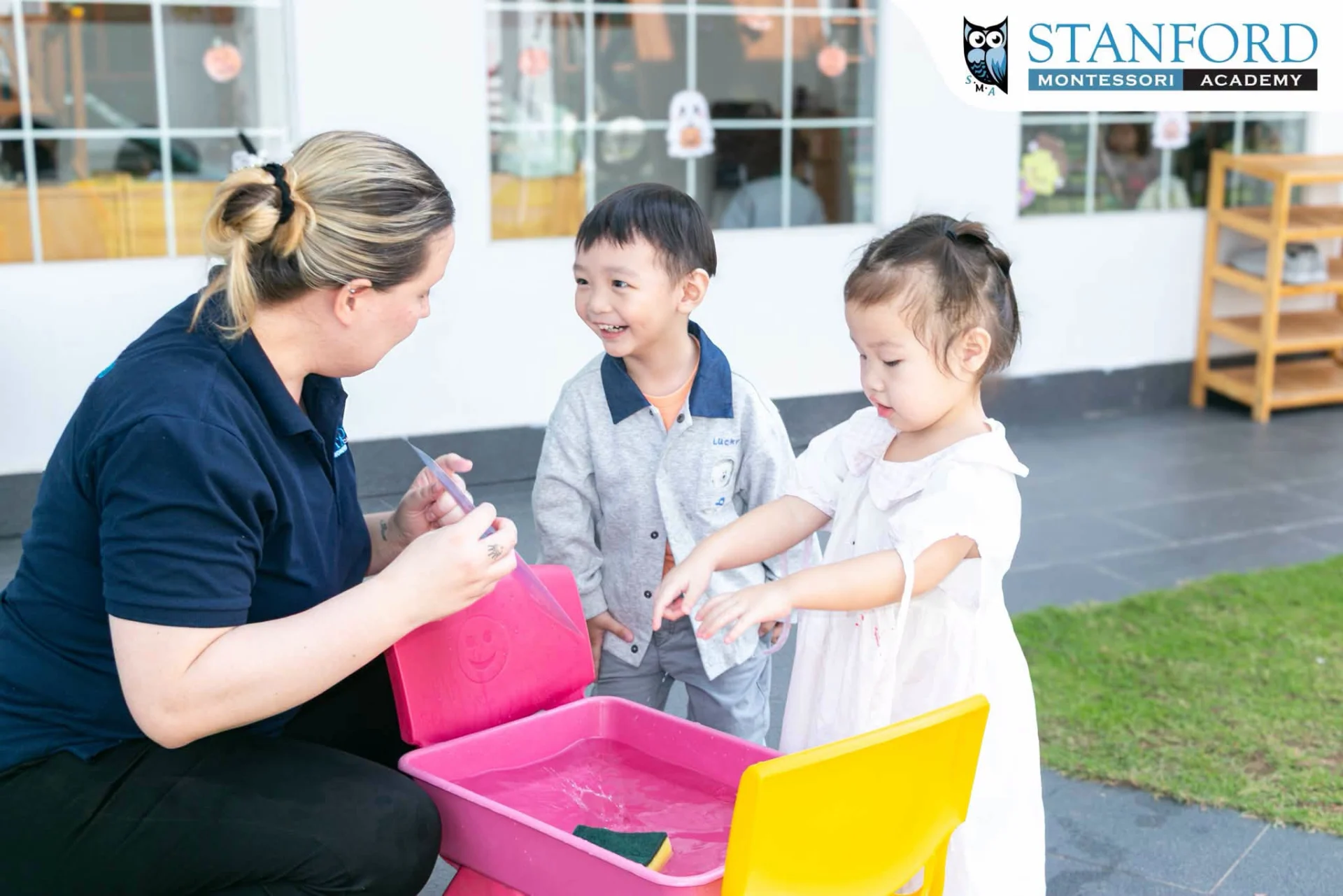
Stanford Montessori Academy in Phnom Penh recently shared a classroom activity in which young children investigated which objects sink or float. The Facebook post describes hands-on water play that encouraged learners to observe what happened, practise new vocabulary and discuss their discoveries. Photographs show children gathered around colourful water containers with adult guidance.

The activity offers a practical example of early science learning through play. Rather than beginning with an abstract explanation, children can handle materials, make predictions and watch the results. The school’s post does not identify the objects tested or provide individual learning outcomes.
Exploring sinking and floating through observation
A sink-or-float activity introduces children to a familiar physical phenomenon. Some objects remain on the water’s surface while others move below it. Young learners can start by describing what they see, comparing objects and noticing that their predictions are not always correct.
Teachers may invite children to predict what will happen before placing an item in water. After observing the result, students can compare their expectations with the outcome. This simple sequence gives children practice in asking questions, checking ideas and explaining observations.
The science behind floating involves buoyancy and the relationship between an object’s weight and the water it displaces. Preschool children do not need a formal physics lesson to benefit from exploring the phenomenon. Clear observations and age-appropriate language provide a useful foundation for later science learning.
Language development during water play
Stanford Montessori Academy specifically mentioned vocabulary practice in its Facebook update. Water activities create opportunities to introduce words such as sink, float, heavy, light, wet, dry, above and below. Children can hear these terms used in context while watching an object move through water.
Educators can extend the conversation with open questions: What did you notice? What happened first? What could we try next? These prompts encourage children to describe actions and make connections between words and experiences.
For multilingual learners, teachers can support understanding through gestures, demonstrations and repetition. The objective is meaningful participation, not simply remembering a list of unfamiliar words.
Hands-on learning and early childhood development
Water play can involve several areas of development at once. Picking up and placing objects encourages hand coordination. Waiting for a turn supports participation in a group. Watching carefully and comparing outcomes gives children practice in sustained attention.
Adults have an important role in keeping these experiences safe and purposeful. Water containers should be shallow, materials should be appropriate for children’s ages and direct supervision is essential. Teachers can also adapt activities so children with different communication or motor abilities can participate.
A single activity cannot establish lasting improvement in scientific reasoning or language skills. Repeated opportunities to explore, talk and revisit ideas allow teachers to observe how children’s understanding develops over time.
Stanford Montessori Academy programmes and campuses
The school’s Facebook post lists a Montessori programme for children aged 1.5 to 6 and primary and secondary programmes covering Grades 1 to 12. It identifies Sen Sok Campus as the kindergarten location and Intradevi Campus as the primary and secondary location.
Sen Sok Campus is listed at #99, Street 1966, Sangkat Phnom Penh Thmey, Khan Sen Sok, Phnom Penh. Intradevi Campus is listed at #20, Street 594, Sangkat Boeng Kak 2, Khan Toul Kork, Phnom Penh.
Families can contact the academy at 069 886 323 or 092 200 523 to ask about admission, programme placement and appointments. The school encourages prospective families to schedule a visit.
The Stanford Montessori Academy sink-or-float activity illustrates how a familiar material such as water can become a starting point for observation, language practice and shared discovery in early childhood education.
If the information about this school is inaccurate or incomplete, Contact Us.
Would you like to register your school? Click Here.


Leave A Comment