
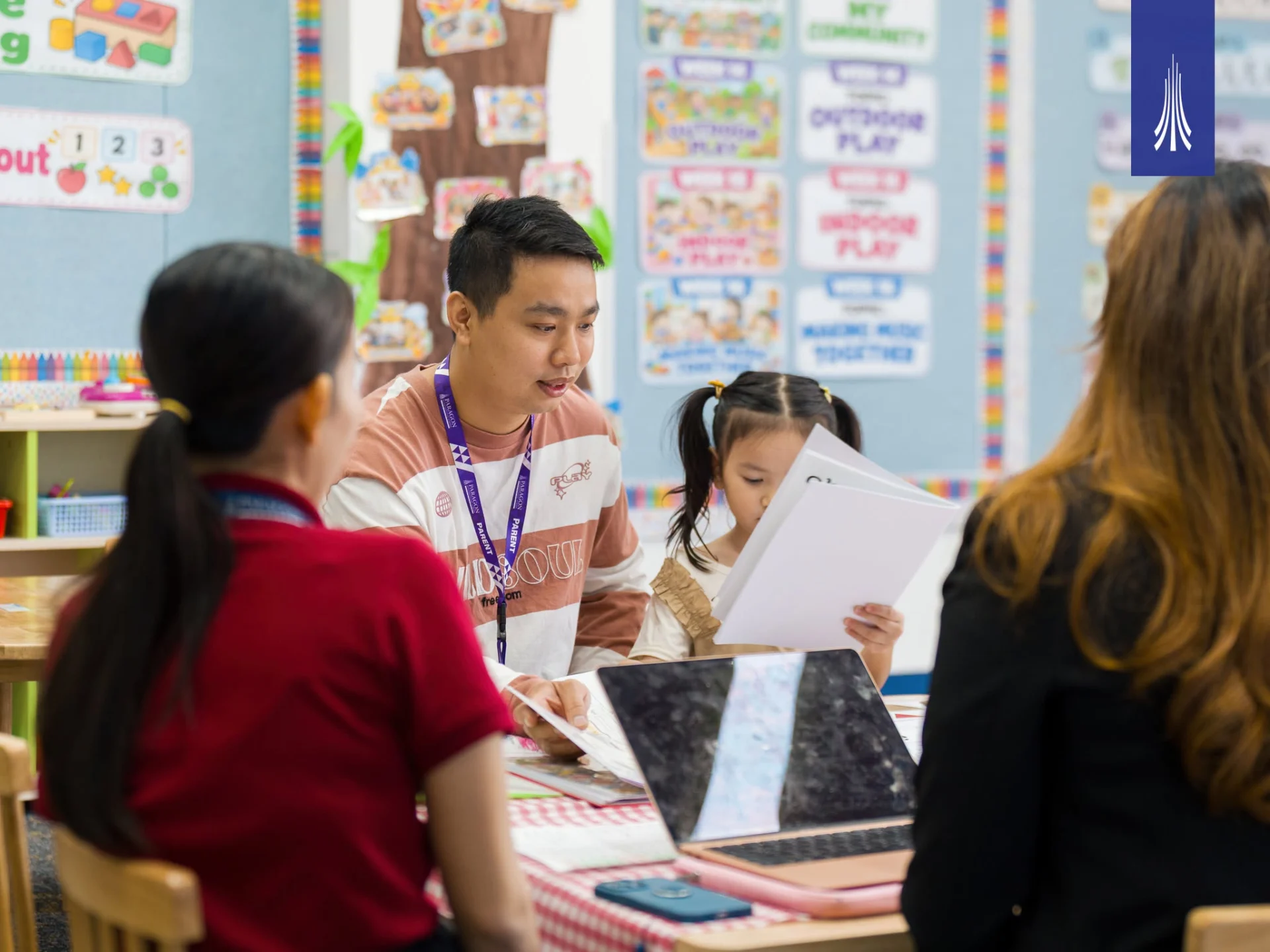

Paragon International School has thanked parents and guardians who attended its Parent-Teacher Conference (PTC), describing the gathering as an opportunity to exchange insights and support students’ learning and development. The school shared photographs of families and educators meeting on campus, alongside a presentation on children’s behaviour in school settings. Its message emphasised the value of communication between home and school.
Paragon International School Parent-Teacher Conference

In its Facebook announcement, Paragon International School expressed appreciation to families who joined the conference. The school said the occasion allowed parents and teachers to connect, discuss students’ progress and work together on their educational journey.
The accompanying photographs show adults speaking with families and a presentation delivered to an audience in a school auditorium. One visible presentation slide is titled “Deconstructing ‘Masked’ Behaviors at School Case Studies” and identifies Hoeur Sethul as a social emotional counsellor.
The post does not specify the full conference agenda, number of attendees or individual student outcomes. It also does not establish whether every family attended the same presentation or participated in separate meetings.
Why parent-teacher communication matters
Parent-teacher conferences create dedicated time for families and educators to discuss how children are learning. Teachers can explain classroom expectations, describe observed strengths and identify areas where a student may need additional support.
Parents contribute information about their child’s interests, routines and experiences outside school. This can help educators understand how a learner approaches tasks in different settings and whether a difficulty is specific to the classroom or appears elsewhere.
A useful conversation focuses on concrete examples. Rather than relying only on general descriptions, families can ask what a child is doing well, which tasks are difficult and what strategies teachers have already tried.
Understanding behaviour across school and home
The visible presentation title raises an important educational topic: behaviour can look different across environments. A student may appear quiet and compliant in class but experience significant fatigue or frustration afterward. Another child may communicate more confidently at home than at school.
Differences between settings do not automatically indicate a particular condition. Educators and families should consider classroom demands, sensory experiences, social expectations, communication needs and other possible explanations before drawing conclusions.
When discussing behaviour, it is useful to identify what happened before an incident, what the child did and how adults responded. These observations can support practical adjustments without attaching labels to the student.
Turning conference discussions into practical support
Families can make parent-teacher meetings more productive by preparing questions about academic progress, friendships, independence and classroom participation. Teachers can share examples of work and explain which goals are priorities for the coming weeks.
When a concern is identified, both parties can agree on a manageable action, such as practising a particular skill, adjusting instructions or using a consistent communication method. A follow-up conversation can help determine whether the approach is useful.
Children also benefit when adults recognise their achievements. Sharing specific examples of progress can reinforce confidence and give families a clearer understanding of the skills being developed.
Building stronger school-family partnerships
Paragon International School’s Parent-Teacher Conference message centred on cooperation between parents, guardians and educators. The school thanked participants for taking time to discuss children’s learning and development.
The Paragon International School Parent-Teacher Conference provides an example of how regular dialogue can help families and teachers share observations, clarify expectations and identify practical next steps for students.
If the information about this school is inaccurate or incomplete, Contact Us.
Would you like to register your school? Click Here.


Leave A Comment