
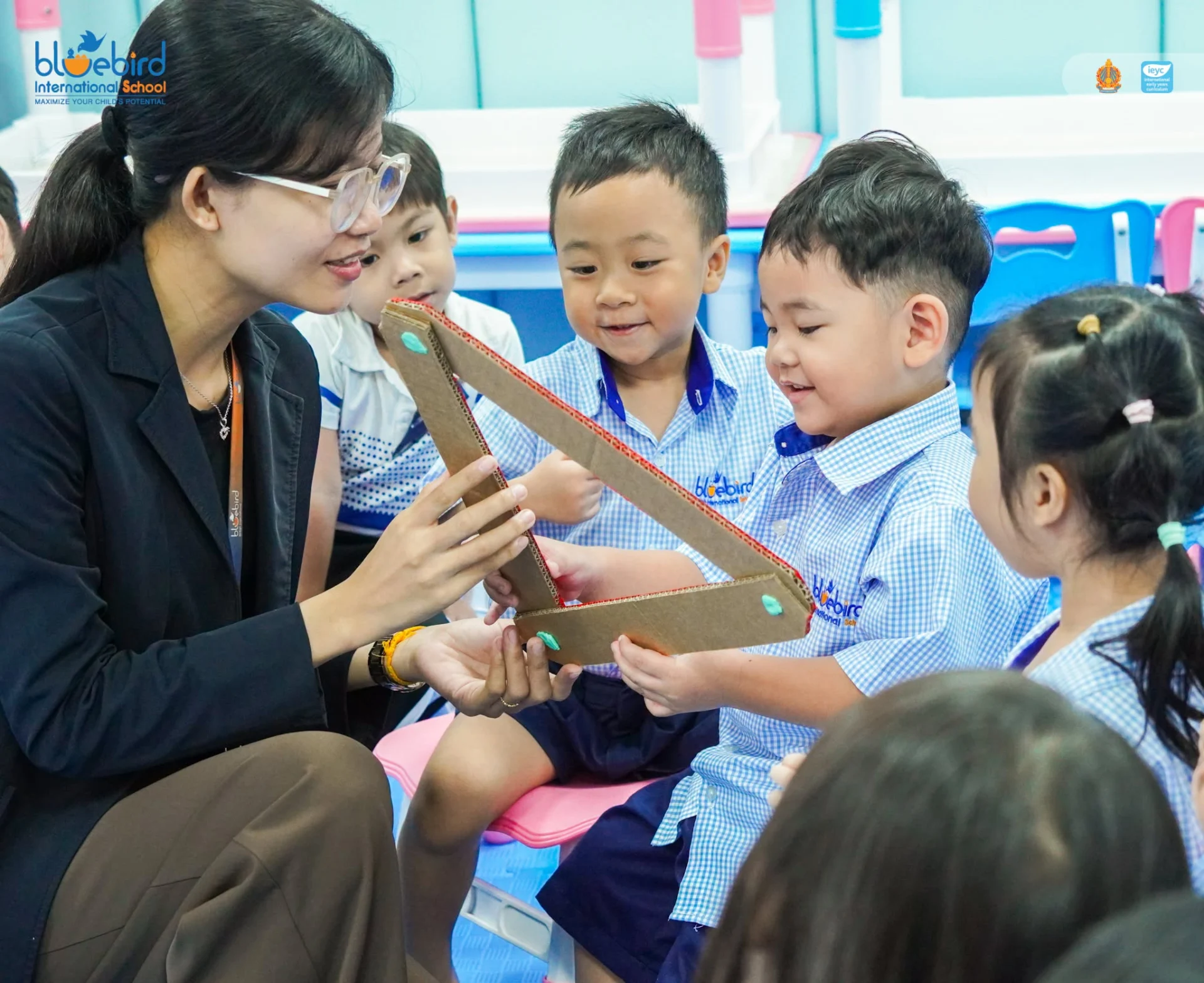

Bluebird International School has shared a Nursery classroom activity introducing children to triangle shapes through observation, touch and practical play. In its Facebook post, the school described how young learners explored the three sides of a triangle, searched for examples of the shape and used coloured paper to practise identifying it. The activities brought an early mathematics concept into a familiar, hands-on learning environment.
Bluebird International School Nursery students explore triangles

According to the school, children began discovering what makes a triangle recognisable. They observed and touched triangle shapes, paying attention to the three sides that distinguish a triangle from other common shapes.
Students also looked for triangles and placed examples on a whiteboard. Another activity involved attaching coloured paper pieces to identify triangle shapes. These tasks offered repeated opportunities to recognise the same geometric form in different materials and settings.
Photographs accompanying the post show teachers working closely with small groups of young children and presenting a large triangular learning material. The images support the school’s description of guided exploration, although they do not establish the complete sequence of the lesson or the children’s individual learning outcomes.
Why hands-on shape learning matters in Nursery
Early geometry begins with noticing similarities and differences between objects. Children may initially recognise a triangle by its overall appearance before learning to describe its sides and corners. Handling examples can help them connect the name of a shape with its visible properties.
Using several kinds of triangles is useful because the shape does not always look identical. A triangle may be tall, wide, tilted or made with sides of different lengths. Seeing these variations can help children avoid assuming that only one familiar drawing counts as a triangle.
Hands-on activities also offer opportunities to develop fine motor coordination. Picking up paper pieces, positioning them on a board and handling classroom materials require controlled movements of the hands and fingers. The main learning goal, however, remains recognising and describing the shape.
Learning through observation, language and play
Teachers can reinforce early mathematical vocabulary by using short descriptions such as three sides and three corners while showing a shape. Asking children to point, match or select a triangle gives them ways to respond even when their spoken language is still developing.
Shape hunts can make the concept more meaningful. Children might look for triangular signs, patterns in books or shapes made from blocks. Adults can compare examples with circles and squares, helping learners notice which features change and which remain consistent.
Young children often need repeated experiences before a new concept becomes familiar. Repetition can remain engaging when teachers vary the materials, encourage movement and allow time for exploration. The Bluebird International School activity used observation, touch and coloured paper to provide these different experiences.
Ideas for parents to practise triangle recognition
Parents can support shape recognition through ordinary play at home. Drawing triangles, arranging craft sticks into three-sided shapes or looking for triangles in picture books can encourage children to notice geometric features. Small objects should be used only with appropriate supervision.
Rather than testing children repeatedly, adults can describe what they see and invite children to explore. Questions such as how many sides a shape has can gradually encourage mathematical language and attention to detail.
Bluebird International School’s Nursery triangle activity illustrates a practical approach to introducing early geometry. By combining visual examples, touch and classroom participation, the school gave young learners opportunities to become familiar with triangles while engaging with teachers and classmates.
If the information about this school is inaccurate or incomplete, Contact Us.
Would you like to register your school? Click Here.
Leave A Comment