
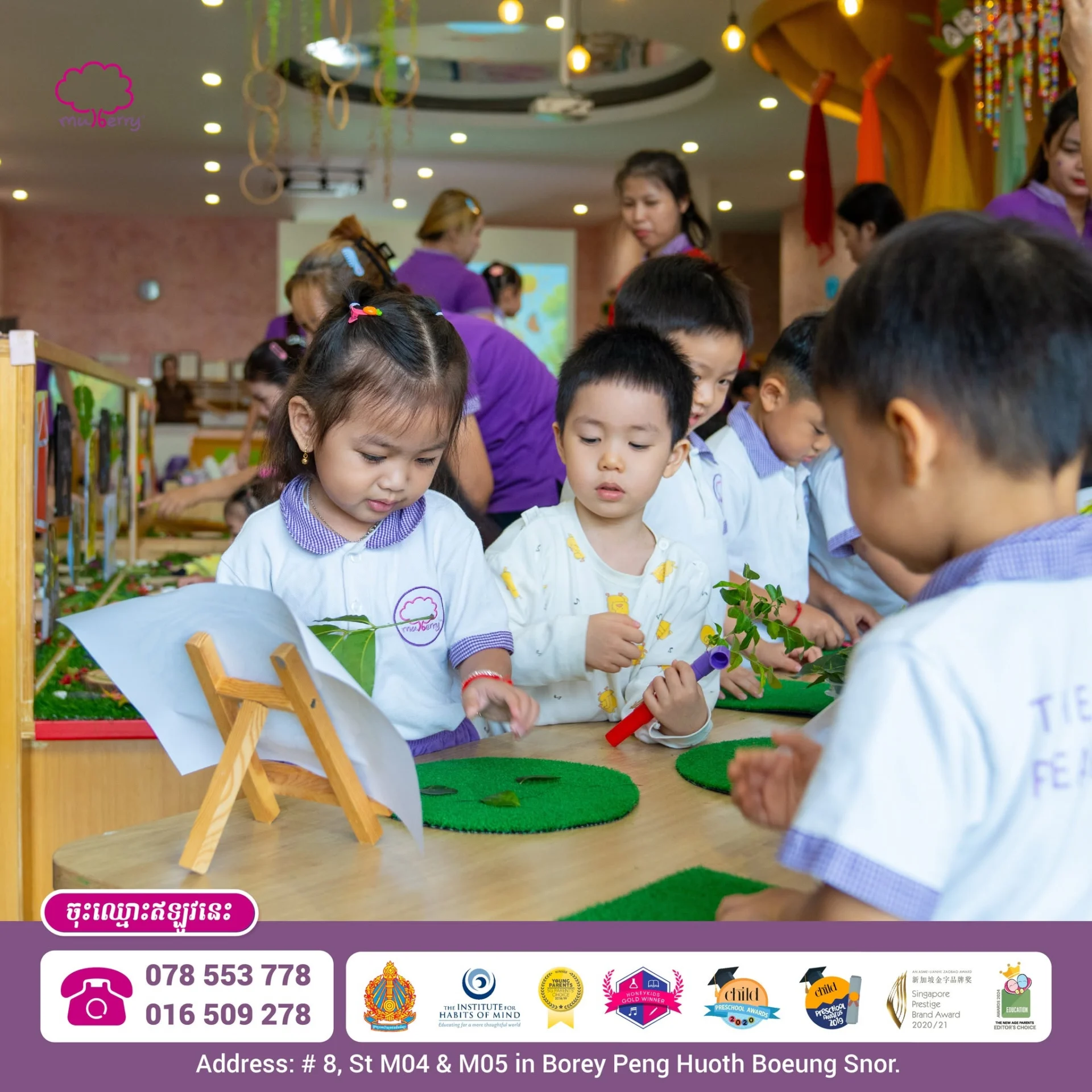

Mulberry International Preschool in Phnom Penh has shared a look at how children can learn through exploring nature and using their imagination. In a Facebook post, the school described observation and hands-on experiences as ways to encourage creativity, problem-solving and independent discovery. Photographs accompanying the post show young children working with leaves, greenery and classroom materials.
Mulberry International Preschool highlights nature-based learning

The school’s message focuses on the idea that nature offers children opportunities to notice details, explore materials and develop their own ideas. Rather than presenting a formal lesson plan, the post describes a general approach to learning through curiosity and direct experience.
In the photographs, one child is shown examining a large green leaf at a table. Other children are gathered around a shared activity with plants and craft materials while adults supervise nearby. The post does not identify the exact tasks or ages of the children.
For preschoolers, everyday natural materials can provide useful starting points for questions. Children might notice differences in leaf shape, compare textures or observe how plants change over time. Educators can encourage this process by asking open-ended questions and giving children time to describe what they see.
How nature activities can support early childhood development
Nature-based learning can involve several areas of early childhood development. Handling safe natural objects offers opportunities to practise careful movements and hand-eye coordination. Sorting leaves by size or colour can introduce early mathematical concepts, while discussing plants and weather can extend vocabulary and observation skills.
Creative activities can also encourage flexible thinking. When children arrange natural materials into pictures or designs, they make choices and consider different possibilities. A teacher may support the process by modelling descriptive language, offering accessible tools and allowing students to try their own solutions.
These are potential benefits of nature-related activities generally. Mulberry International Preschool’s Facebook post does not provide assessment results or evidence that particular developmental outcomes were measured during the pictured activities.
Creating meaningful hands-on experiences for young children
Practical exploration is most useful when it is appropriate for a child’s age, interests and abilities. Teachers can introduce a small selection of materials, explain any safety rules and observe how children engage. Some children may prefer touching and arranging objects, while others may enjoy drawing what they discover or discussing their observations.
Adults can make these experiences more inclusive by providing different ways to participate. For example, a child who dislikes a particular texture could use a tool or look closely at an object without touching it. Clear routines, supervision and careful selection of materials help make activities manageable for a range of learners.
Families can try similar ideas at home using clean leaves, large stones or other safe objects. Simple activities include comparing shapes, making leaf rubbings or observing a plant over several days. Parents should avoid poisonous plants, choking hazards and sharp objects, and supervise children throughout.
Mulberry International Preschool offers school tours and a free trial
Alongside its nature-learning message, Mulberry International Preschool invited families to arrange a free school tour and a one-week free trial. The post directed readers to the comments for further details. It did not specify eligibility conditions, available dates or other terms of the offer, so interested parents should confirm these directly with the school.
For parents evaluating preschool options, a visit can be an opportunity to observe how teachers guide play, organise materials and respond to children’s questions. Families may also ask how the school balances creative exploration with routines, communication and individual support.
The Mulberry International Preschool nature-learning post presents an example of children engaging with natural materials and exploring ideas in a supervised setting. Its emphasis on observation, creativity and hands-on discovery offers a useful perspective on everyday learning in early childhood education.
If the information about this school is inaccurate or incomplete, Contact Us.
Would you like to register your school? Click Here.
Leave A Comment