
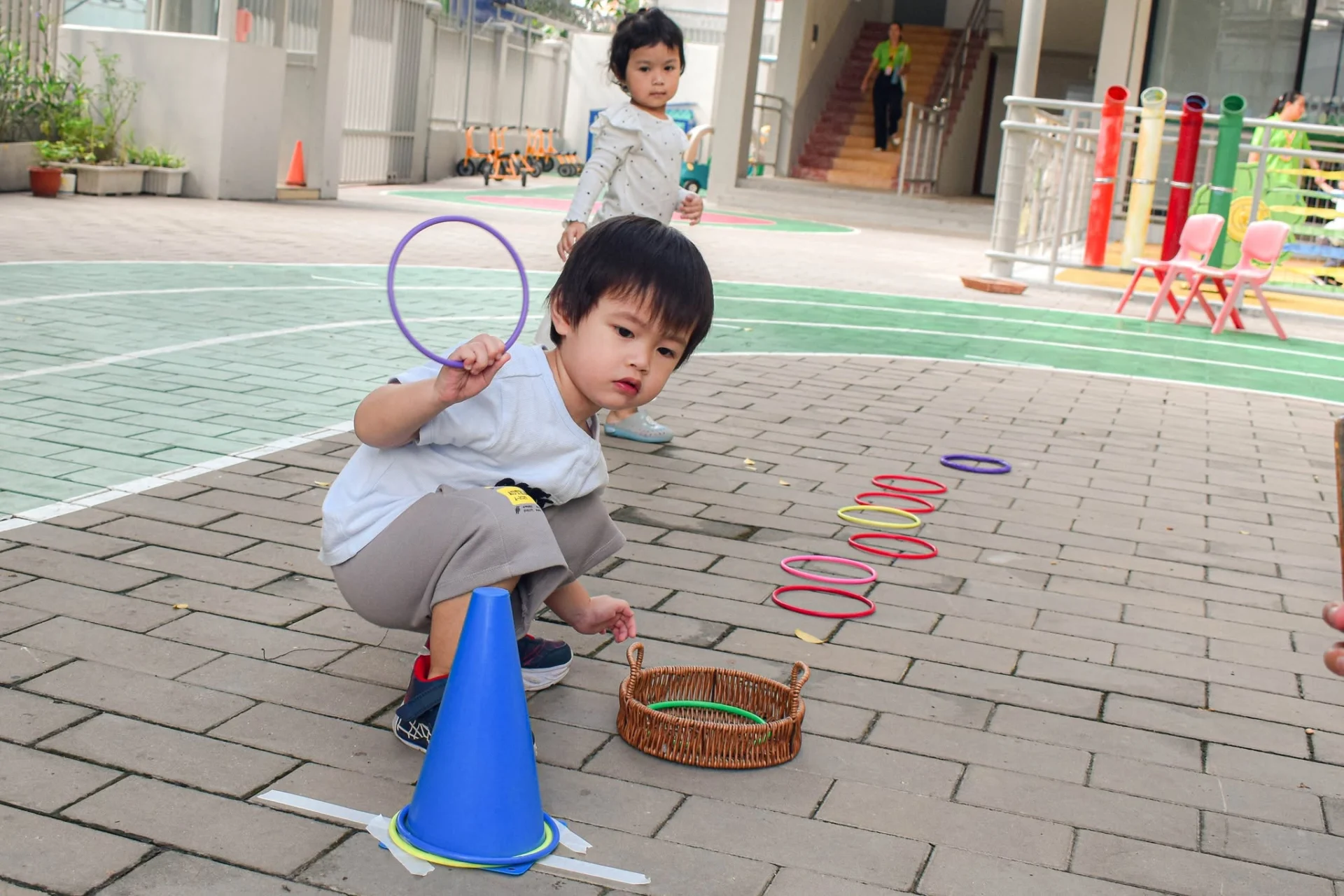
Kinderland Cambodia has shared a Pre-Nursery activity called the KinderFIT Hoops Relay, in which young children collected colourful hoops and placed them over cones. The school’s Facebook post describes a playful movement session that encouraged coordination, balance, following instructions and teamwork. Photographs show children participating outdoors with hoops and cones arranged across a paved activity area.
Kinderland Cambodia KinderFIT Hoops Relay activities

During the relay, children moved to collect hoops one at a time before carefully placing them over cones. This straightforward task combined movement with a clear goal. The school described children cheering for their friends and enjoying the experience as they took turns.
The activity was designed for Pre-Nursery learners. Rather than reporting competition results or identifying winners, the post focused on participation, encouragement and the skills children could practise. Its photographs show individual children holding hoops and moving between markers, but do not establish a formal race format or measured outcomes.
For young children, repeated movement tasks can offer practice in planning a simple action, carrying it out and adjusting when something does not go as expected. A hoop that misses a cone, for example, provides a natural opportunity to try again and refine hand movements.
How relay games support early motor development
Gross motor skills involve large movements such as walking, running, bending and maintaining balance. In a hoop relay, children may use these skills as they travel between stations, reach for an object and position themselves near a cone.
Hand-eye coordination also matters. Children need to look at the hoop and the target, guide their hands and adjust the placement. These actions can be practised through many everyday games, including stacking, throwing soft objects into baskets and moving toys between containers.
The school also highlighted agility and balance. These abilities develop gradually, and activities should be adapted to each child’s age and current movement skills. Some children may walk rather than run, use larger hoops or need a closer target. The aim is meaningful participation and safe practice.
Turn-taking, teamwork and following instructions
Movement games can provide opportunities to practise social and communication skills alongside physical development. Waiting for a turn, listening to a short direction and encouraging another child are all useful early learning experiences.
Adults can make the instructions easier to follow by demonstrating each action, using simple language and repeating the sequence consistently. Visual examples and extra time may help children who are still learning to process multi-step directions.
The Kinderland Cambodia post described children cheering for their friends during the activity. Such moments can create opportunities to notice others’ efforts and participate in a group, even when children complete the physical task individually.
Practical ideas for parents and early years teachers
A similar game can be organised with lightweight rings and stable targets, provided the space is clear and adults supervise. Children can carry one ring at a time, walk to a marker and place it over a cone. The distance and number of steps can be adjusted to suit their abilities.
Teachers and parents can observe how children approach the activity without treating a single game as an assessment. Progress may appear in greater confidence, more controlled movements or increased willingness to take turns over repeated opportunities.
Kinderland Cambodia’s KinderFIT Hoops Relay illustrates how a simple Pre-Nursery movement game can combine physical practice with shared play. The school’s account emphasises enjoyment, encouragement and participation as children learn through active experiences.
If the information about this school is inaccurate or incomplete, Contact Us.
Would you like to register your school? Click Here.
Leave A Comment