
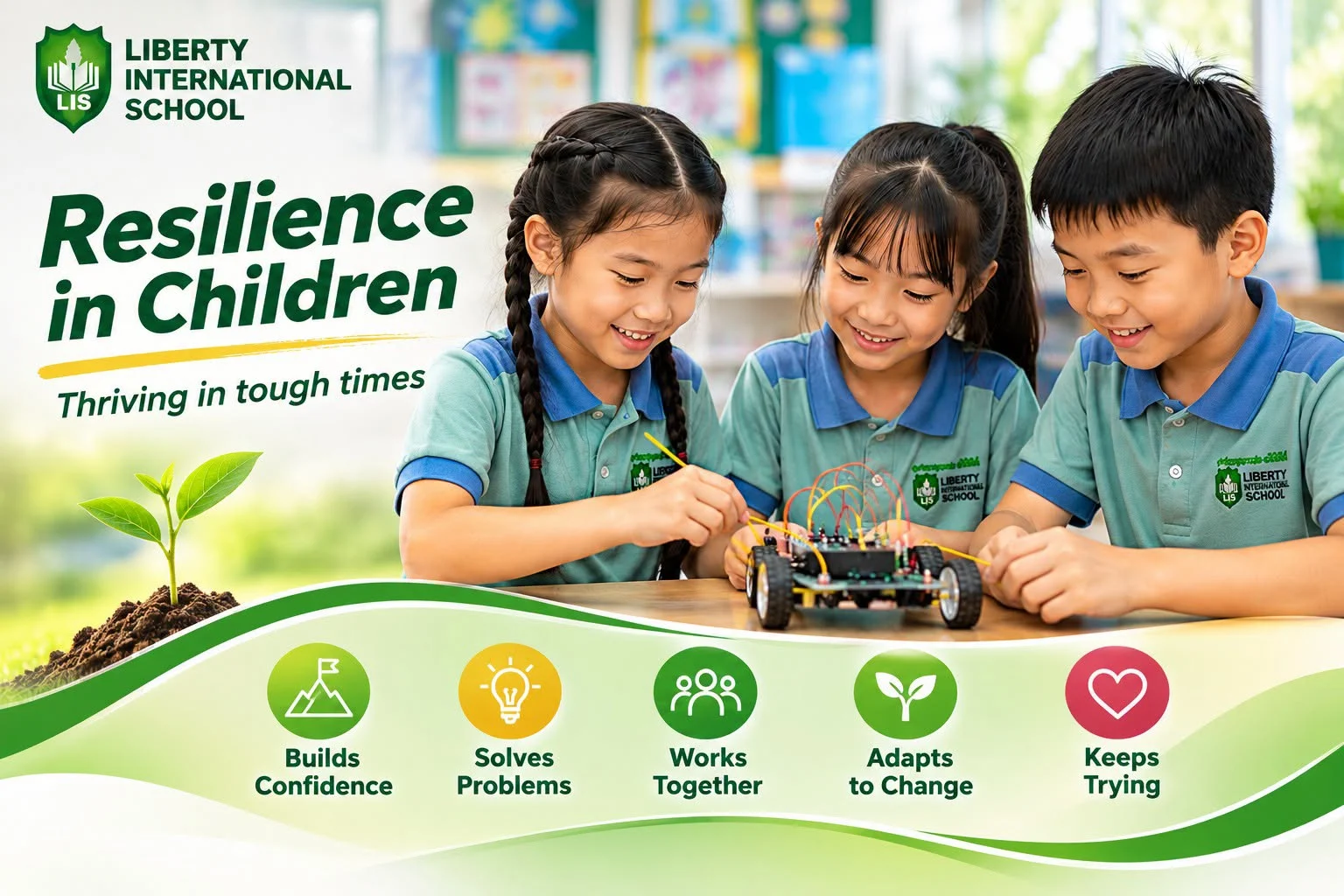

Liberty International School in Tuol Kok, Phnom Penh, used a Facebook post to discuss resilience in children. The school described resilience as the ability to adapt, recover from setbacks and keep trying when something is difficult. It pointed to hands-on STEAM activities, teamwork and supportive classrooms as ways children can practise responding to challenges. The post also described the school’s language programme as bilingual, with trilingual learning in primary.

For families comparing schools, the post raises a practical question. When a child gets stuck, what kind of help do they receive, and what are they able to try for themselves? The answer can be easier to see in a classroom routine than in a programme description.
How classroom activities can build resilience in children
The school’s preschool and kindergarten programme page describes guided STEAM activities that ask children to experiment, make things and solve simple problems. A teacher could use a task such as building a bridge from paper to give children a manageable setback. If the bridge bends under a toy, the group can look at where it bent and decide whether to fold the paper or move the supports closer together.
The adult’s response matters. A teacher can ask what the child has already tried, demonstrate one step if needed, and let the child decide what to test next. In a group task, children can take turns describing what happened and suggesting a change. That gives them practice listening to a different idea and trying it together.
For a child who is learning in more than one language, demonstrating an idea may be easier than explaining it in a full sentence. A drawing, gesture or model can give the child a way to take part while they develop the words to describe their thinking.
How families can support a child after a setback
At home, parents can help a child name the difficulty and choose one next step. If a puzzle feels overwhelming, a parent might suggest finding two corner pieces together before the child chooses where to look next. If the child is too frustrated to continue, a short break can make it easier to return to the task.
Feedback is most specific when it describes what the child did. A parent who notices that a child turned a puzzle piece or asked for a clue gives the child an action they can try again. Teachers can use the same approach during transitions, group projects or independent work by naming the step that helped a student get started again.
What to ask Liberty International School during a visit
The Facebook post lists primary Grades 1–6 and advertises preschool for ages 2–6. The school’s preschool and kindergarten programme page lists ages 3–6. Families considering enrolment for a two-year-old should confirm which classes are currently available. Parents can also ask how the school uses English, Khmer and Chinese at different grade levels and what support a child receives when they are new to a language used in class.
To see how a school supports resilience in children, ask a teacher to describe a recent classroom task that students found difficult. Listen for what the teacher did, what the students tried next and how they could ask for help. That example can show how the school handles the small setbacks children encounter during an ordinary day.
If the information about this school is inaccurate or incomplete, Contact Us.
Would you like to register your school? Click Here.
Leave A Comment