
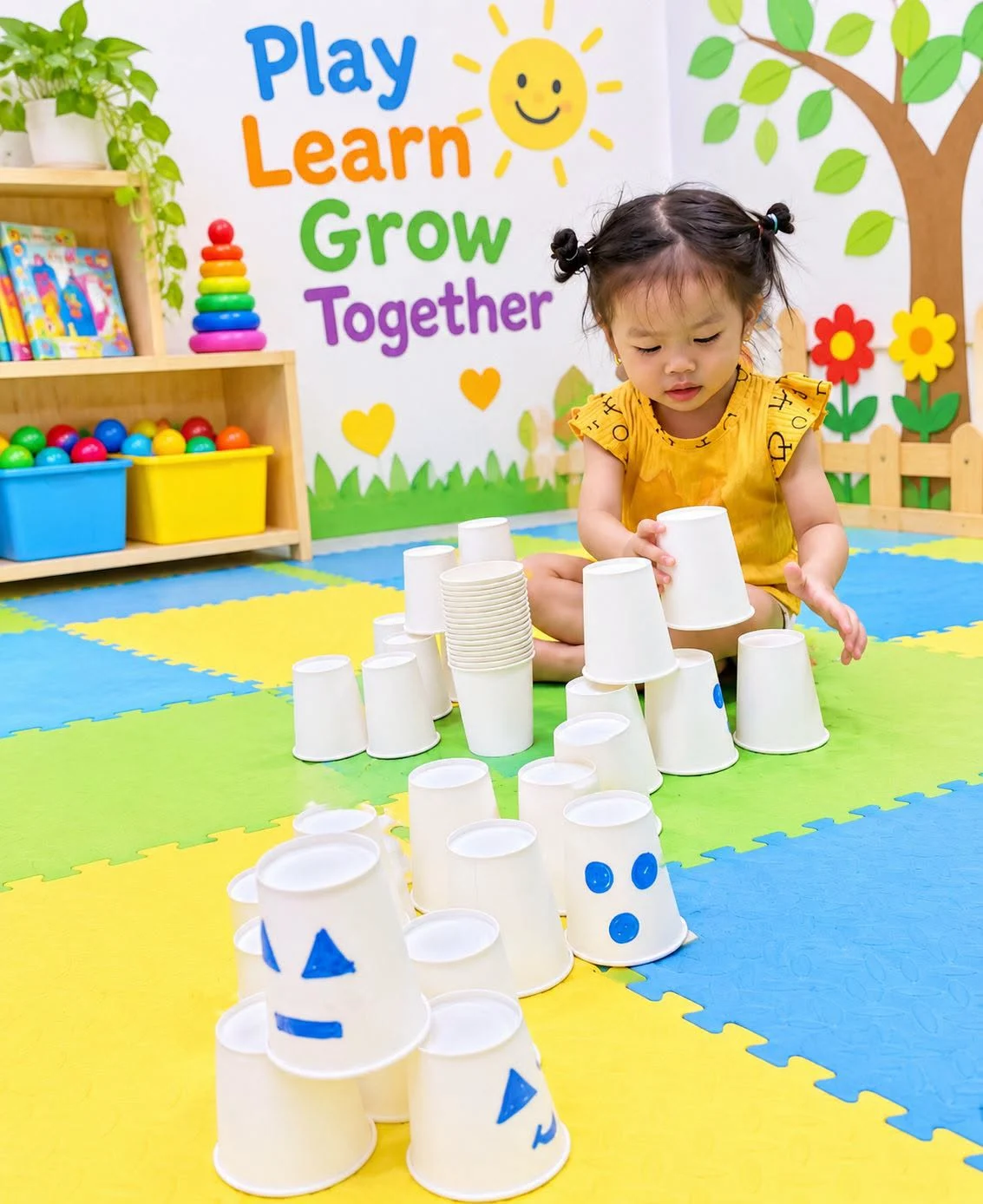

Happy Daycare Phnom Penh Cambodia shared a Facebook post about cup stacking, a play activity that asks children to arrange and build with paper cups. The caption links the activity to skills such as hand-eye coordination, concentration and problem-solving. The accompanying image, which Facebook labels as AI content, illustrates the setup with a child, white paper cups and a colourful play mat.
How cup stacking gives children practice with precise movements

Picking up a cup and setting it down involve different movements. A child has to grasp the cup firmly enough to lift it, then adjust their grip to release it where they want it to go. When stacking one cup on another, they also have to judge where the edges line up. An adult can observe whether the child moves quickly, slows down near the stack or uses their other hand to steady the base.
The materials can change the task. Wide cups give a child more room to place the next cup. A firm floor or low table keeps the base steady while the child practises. If a child finds a tall stack frustrating, an adult can set out two or three cups and let the child decide whether to build up, place the cups side by side or fit them inside one another.
Building, testing and trying again
A stack that tips over gives children something concrete to investigate. They can try moving the bottom cups farther apart or lowering the height of the structure. An adult can describe what happened in plain language, such as saying that the top cup slipped when the base moved. That gives the child a clue while leaving the next attempt in their hands.
Some children will repeat one arrangement several times. Others may try a different shape as soon as the first one falls. Teachers can watch how children approach the materials and decide when to offer help. If a child is still engaged, a brief pause gives them time to adjust the cups independently. When help is needed, holding the base steady can leave the child in charge of placing the next cup.
A simple version families can try at home
Set out a few clean paper cups on a clear surface and show how to place one upside down. Invite the child to add another cup or start a separate stack. An older preschooler might enjoy copying a simple arrangement with two cups on the bottom and one on top. A younger child may spend more time picking cups up, turning them over or fitting one inside another.
The same activity can introduce language about position and quantity. An adult might describe one cup as beside another or count the cups after the child finishes building. When two children share the materials, they can each build part of a structure or take turns adding a cup. Keep the directions short enough that the children still have time to experiment.
Cup stacking, as described by Happy Daycare Phnom Penh Cambodia, is an example of how a familiar material can support play with a clear physical challenge. Families and teachers can adjust the number of cups or the size of the structure according to what a child can handle comfortably. A few minutes of focused play can give an adult a clearer picture of how the child grips, places and adjusts objects.
If the information about this school is inaccurate or incomplete, Contact Us.
Would you like to register your school? Click Here.

Leave A Comment