
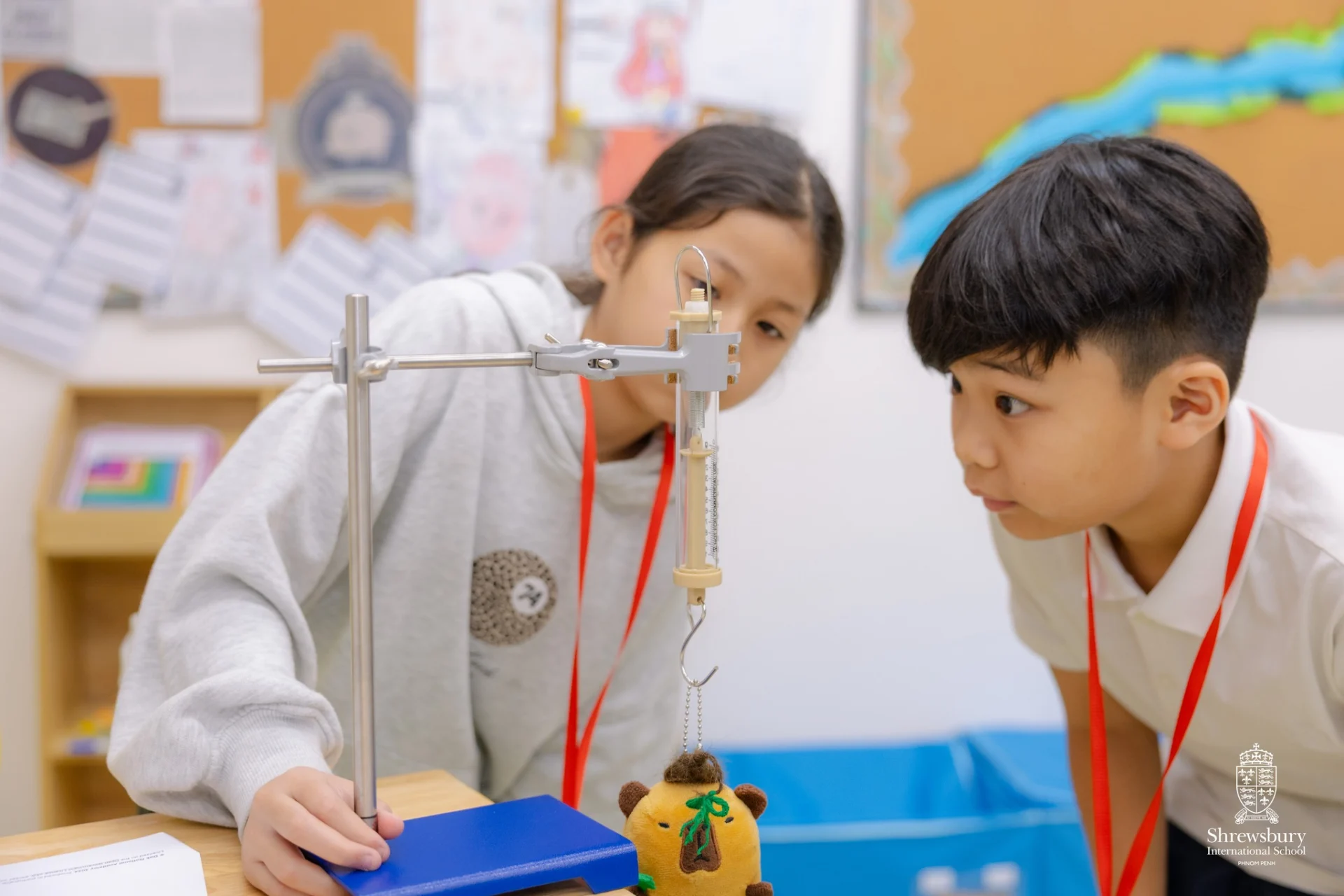

Physics education in Cambodia is evolving, with international schools placing a stronger emphasis on hands-on, inquiry-based learning. A recent classroom activity at Shrewsbury International School Phnom Penh highlights how practical science lessons can deepen student understanding while building essential academic and life skills. The lesson, focused on measuring forces, demonstrates how abstract physics concepts become meaningful when students actively engage with real experiments.
From the outset, this physics education in Cambodia example shows a clear commitment to experiential learning. Rather than relying solely on textbooks or theoretical explanations, students worked directly with force meters to explore how gravity acts on different objects. By measuring forces in newtons, learners were able to visualize the invisible pull of gravity and understand how mass influences force. This approach bridges the gap between theory and real-world application, making physics more accessible and memorable for students.
Learning Physics Through Investigation
Inquiry-based science education is central to effective learning, and this lesson reflects that principle well. Students tested a variety of everyday objects, observing how springs extend under tension when different masses are applied. This simple yet powerful experiment allowed learners to compare results, identify patterns, and discuss why heavier objects produced greater force readings. Such activities encourage analytical thinking and help students develop a scientific mindset grounded in observation and evidence.
In the context of physics education in Cambodia, these investigative methods are particularly valuable. They support students who may come from diverse educational backgrounds by providing equal opportunities to engage, experiment, and understand through doing rather than memorization alone.
Building Precision and Data Literacy
Another important aspect of the lesson was the focus on accuracy and measurement skills. Students practiced reading scales precisely and recording results carefully, reinforcing the importance of reliable data in science. These skills are foundational not only for physics but also for higher-level science subjects and future academic research.

Working in pairs further strengthened collaboration and communication. Students discussed their findings, cross-checked measurements, and learned to explain results clearly. This mirrors real scientific practice, where teamwork and peer review are essential. For parents and educators, this demonstrates how well-designed science lessons can simultaneously develop subject knowledge and transferable skills.
Supporting Whole-Child Education
Beyond physics content, the activity reflects a broader educational philosophy. Hands-on experiments promote curiosity, confidence, and engagement, particularly for learners who thrive through tactile and visual experiences. Teachers guided students without giving direct answers, encouraging independent thinking and problem-solving.
This model of teaching aligns with international best practices and sets a strong example for physics education in Cambodia. By fostering curiosity and resilience, schools prepare students not only for examinations but also for lifelong learning.
Why This Matters for Cambodian Education
As Cambodia continues to expand its international and bilingual education sectors, examples like this lesson provide insight into what high-quality science education looks like in practice. Physics education in Cambodia benefits when schools invest in well-equipped classrooms, trained educators, and student-centered methodologies.
For parents exploring schooling options and professionals working in education, such classroom experiences highlight the value of practical science learning. They show how global curricula can be adapted meaningfully within the local context, ensuring relevance, rigor, and engagement.
If the information about the school is not accurate or sufficient, please Contact us.
Do you want to register your school? Click here.



Leave A Comment