
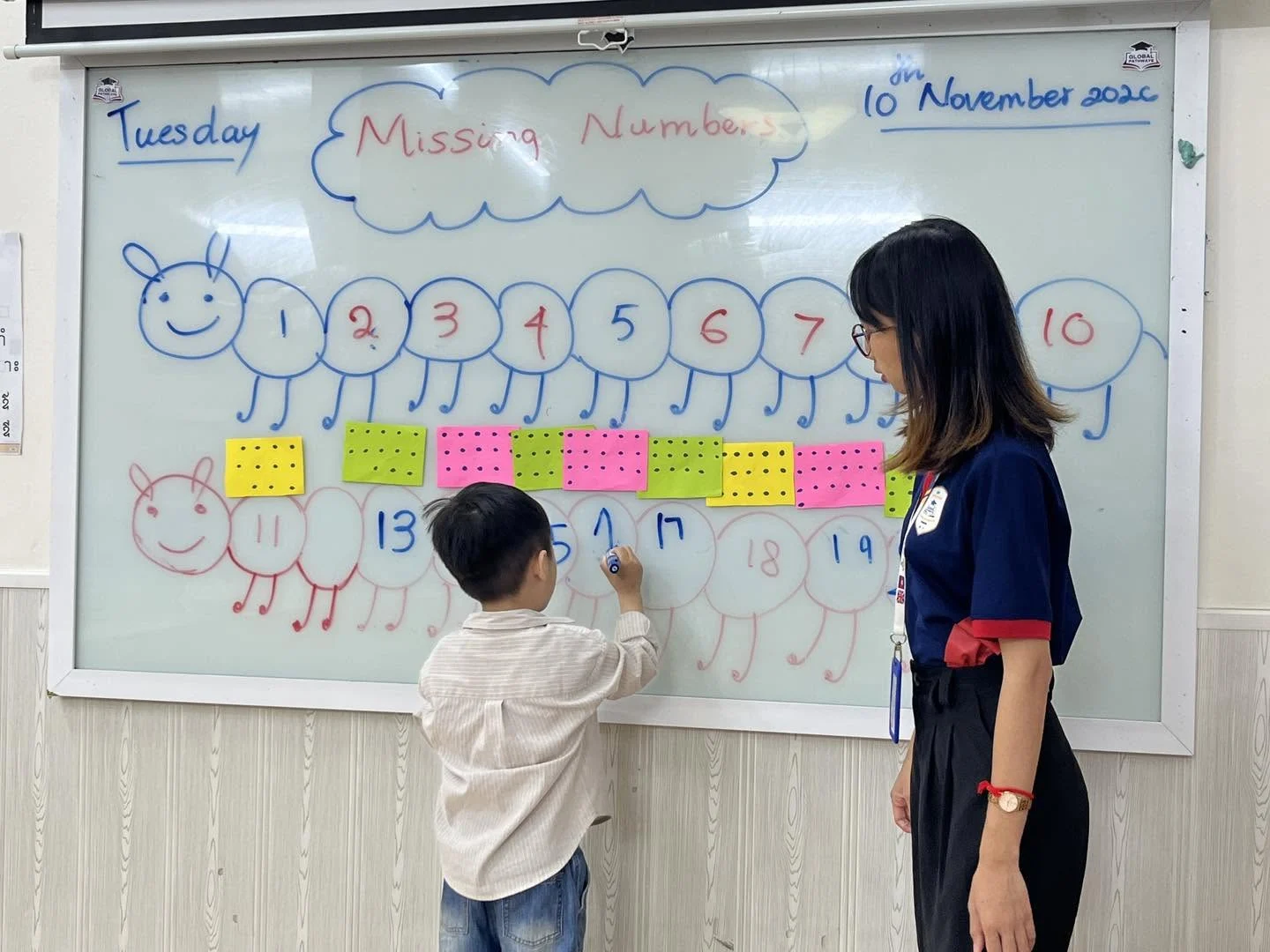

Global Pathways School shared a Facebook post showing a missing numbers lesson led by Ell Sandi Kyaw. The classroom photographs show children working at a whiteboard with two caterpillar-shaped number sequences and coloured cards. The board is headed “Missing Numbers” and dated 10 November 2026. The activity puts a familiar counting sequence in front of children and asks them to work out what belongs in a gap.
How the missing numbers lesson uses a visual sequence

On the board, the caterpillars’ circles provide a space for each numeral. The upper sequence begins at one and runs to ten. The lower sequence shows numbers in the teens, with several positions partly covered or left to complete. In the photos, children stand close to the board and point or reach towards the cards while their teacher stands beside them.
A row of separate spaces makes it possible to point to each position while counting. If a child sees 12, 13 and a blank, they can say the numbers aloud and stop at the empty space. Seeing 15 on the other side gives them another way to check their answer. The task connects the spoken number word to a written numeral and to its position in the sequence.
What teachers can learn from a child’s answer
Two children can fill in the same gap using different approaches. One may count from one until they reach it. Another may start with the number just before the gap. Asking a child to show how they worked it out gives the teacher more information than the answer alone. It can show which starting points are familiar and whether the child uses nearby numbers to check their work.
A wrong answer can also help a teacher decide what to practise next. A child who says the right number and chooses a different card may need more practice matching spoken numbers to written numerals. A child who skips a number while counting may benefit from pointing to one space at a time. If the row runs through the teens, keeping the other numbers visible lets the child refer back to the sequence.
How families can practise number order at home
Write the numbers one to five on separate slips of paper and lay them in a row. Count through the row together. Then cover one numeral in the middle and ask the child to find the slip that fits. If the child wants to start counting from one each time, let them. Once they are comfortable, invite them to try starting with the number just before the covered space.
Families can also use a shorter sequence with a different starting point, such as six, seven, a blank and nine. Leave one gap at first so the child can focus on the surrounding numbers. To connect the sequence with quantity, have the child count out a matching group of blocks after choosing the missing numeral. This gives them a separate way to show what the number represents.
The missing numbers activity shared by Global Pathways School illustrates how a visual prompt can make children’s counting strategies easier to observe. At home or in class, begin with a sequence the child already knows, leave the neighbouring numbers visible and ask them to show how they found the answer. Their explanation can guide the choice of the next sequence.
If the information about this school is inaccurate or incomplete, Contact Us.
Would you like to register your school? Click Here.


Leave A Comment