
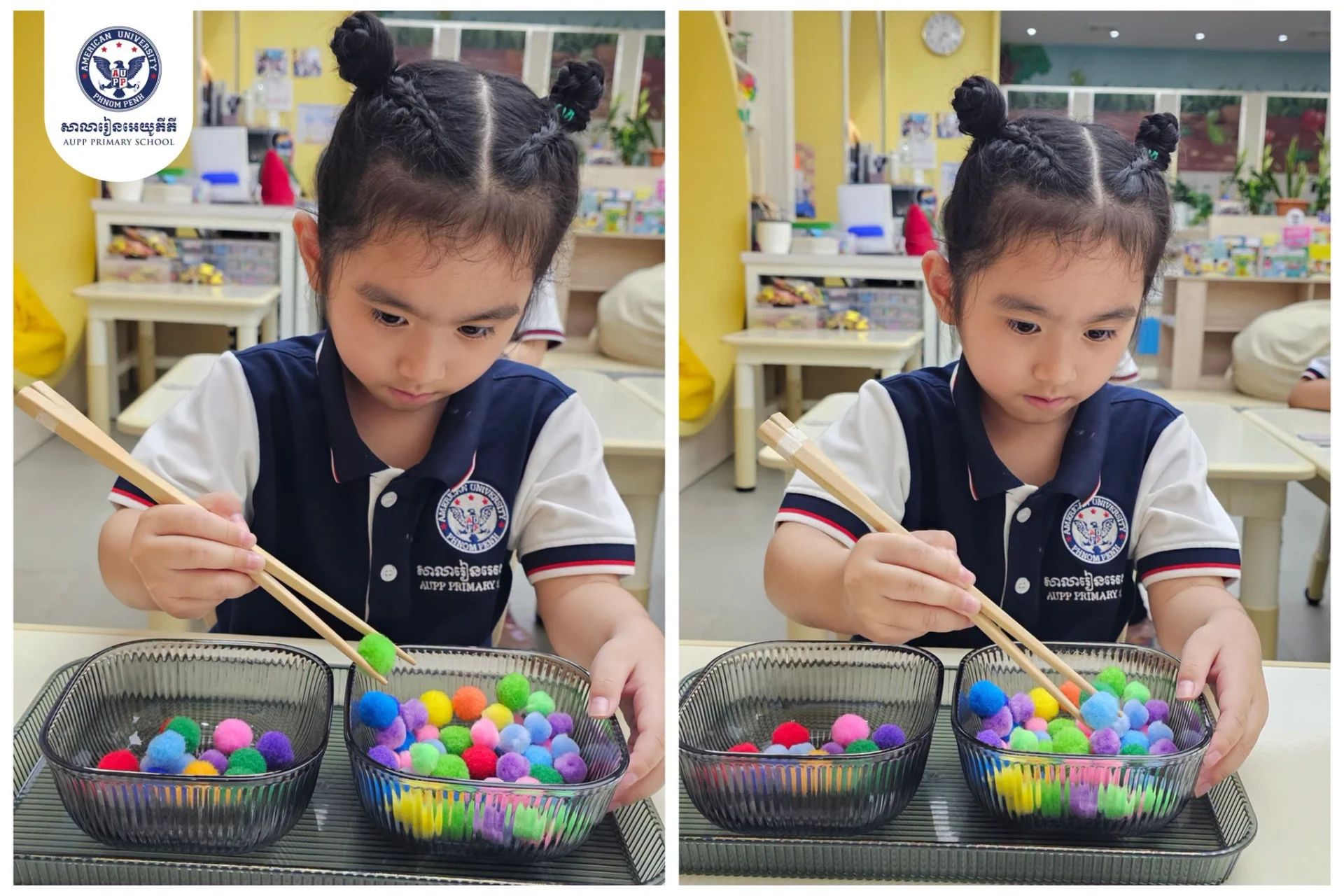
AUPP High School – Foxcroft Academy shared a classroom activity from AUPP Primary School in which K3 learners used chopsticks to transfer colourful fuzzy balls. The hands-on task encouraged children to practise controlled movements, concentration and coordination while participating in a playful learning experience.
AUPP Primary School K3 learners explore fine motor skills

The school introduced the activity under the theme “Little Hands, Big Skills!” and described it as a simple task with several learning objectives. Children used chopsticks to pick up fuzzy balls and move them between containers, an exercise that required careful hand movements and attention.
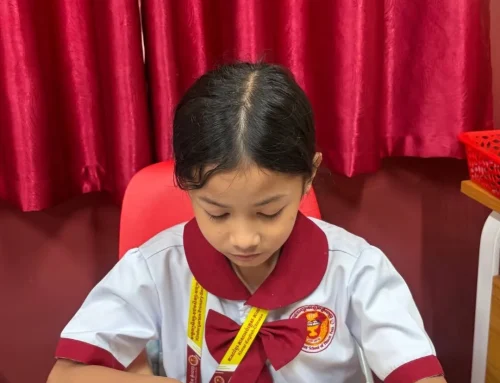
The accompanying photographs show students in school uniforms working with small, brightly coloured balls and chopsticks at classroom tables. Their materials were arranged in trays, allowing each learner to practise the task directly.
The activity was presented as an opportunity to learn through play. Rather than relying on a worksheet, the children manipulated physical objects and repeated movements while working toward a clear goal.
How the chopsticks activity supports hand-eye coordination
According to AUPP Primary School, one objective was to strengthen fine motor skills, which involve the small muscles of the hands and fingers. Using chopsticks requires children to adjust their grip and control the position of the tool as they attempt to pick up an object.
The school also highlighted hand-eye coordination. Students needed to look at each fuzzy ball, guide the chopsticks toward it, lift it and transfer it to another position. These steps brought visual attention and hand movement together in a single task.
Activities of this kind can provide repeated practice with controlled movements. The degree of difficulty depends on factors such as the size of the objects, the chopsticks used and each child’s existing skills. The post does not report formal measurements of improvement.
Focus, problem-solving and independence
AUPP Primary School identified focus and concentration as further goals. Children were encouraged to pay attention and complete each step carefully. Picking up and moving the fuzzy balls required them to stay engaged with the task and adjust their actions when necessary.
The school also described the activity as an exercise in problem-solving. Students explored how to grip, lift and transfer objects with control. If an object slipped or was difficult to hold, the task offered another chance to change the position of the chopsticks and try again.
Patience and independence were additional themes in the school’s account. Repeating a task gives children opportunities to practise at their own pace and gradually become more familiar with the movements involved.
Hands-on learning in early childhood classrooms
The activity illustrates how everyday classroom materials can be used for purposeful practice in early childhood education. Fuzzy balls, containers and chopsticks created a practical task with visible steps and an immediate result when a ball was successfully transferred.
For teachers, such tasks can be adapted by changing the number of objects, the size of the materials or the amount of guidance provided. These are general examples of classroom adaptations, rather than specific adjustments reported by the school.
The original announcement emphasised enjoyment alongside learning. The school described the K3 learners as practising movements, focusing on the task and developing skills that support everyday learning.
More information about AUPP Primary School
Families interested in the school’s programmes can consult the AUPP High School – Foxcroft Academy website or contact the admissions team using the numbers provided in its post: +855 23 902 111, +855 77 584 797 and +855 86 802 111.
The AUPP Primary School K3 chopsticks activity brought together fine motor practice, hand-eye coordination, attention and problem-solving in a classroom setting. It offered children a chance to explore these skills through a concrete, hands-on learning task.
For corrections or additional information, Contact Us. To register your school, Click Here.
Leave A Comment