
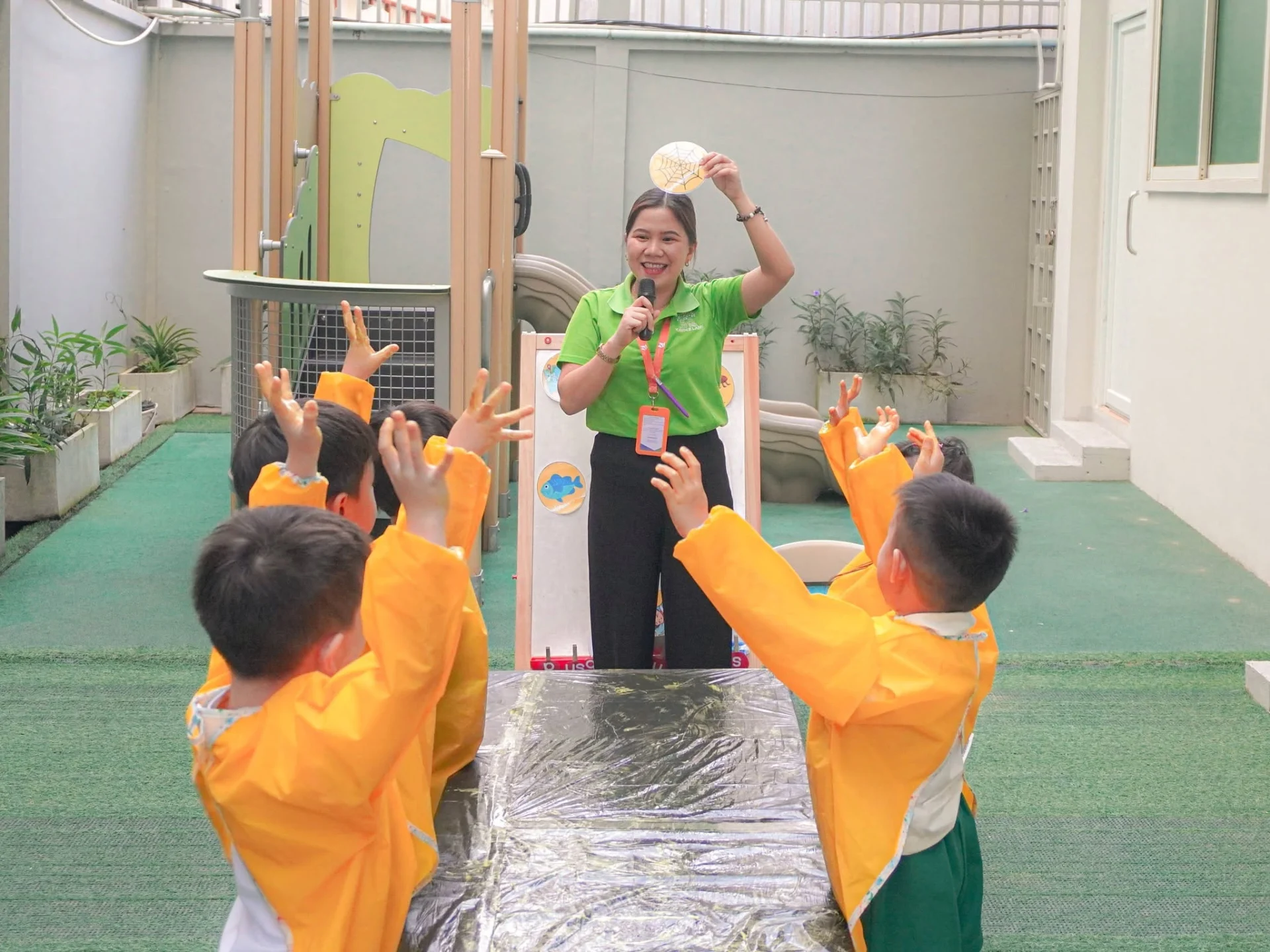

Kinderland Cambodia has shared a Kindergarten 1 phonics activity that combines music, movement, picture recognition and sensory writing. In the activity, called “Listen, Move, Sound & Learn,” children listened to music, responded when it stopped, identified a picture, pronounced its ending sound and traced the corresponding letter with their fingers. The school described the exercise as a playful way to practise phonics, listening and fine motor coordination.
Kinderland Cambodia introduces sensory phonics learning

According to the school’s Facebook post, the activity began with children listening and moving to a musical rhythm. When the music stopped, they raised their hands to identify a picture shown by the teacher. They then said the word aloud, blended the letters, identified the ending sound and wrote the corresponding letter on a sensory surface.
This sequence connected several tasks within one game. Children needed to notice a change in the music, shift their attention to the teacher, process the picture and respond with speech and movement.
The photographs show children in orange clothing participating in a supervised outdoor learning activity. The announcement does not identify the specific letters practised or describe how individual learners performed.
How phonics supports early reading
Phonics instruction helps children understand relationships between speech sounds and written letters. For example, recognising the final sound in a spoken word requires listening closely to the word’s individual sounds, a skill related to phonemic awareness.
Blending sounds helps learners connect individual sounds into words. In early literacy instruction, teachers can model a word slowly, ask children to listen for its sounds and then guide them to say the word smoothly.
Children develop these abilities at different rates. A playful activity can provide useful practice, although it does not by itself establish that a child has mastered a particular reading skill.
Music and movement in the classroom
The musical component gave the children a clear signal for when to move and when to stop. Games with predictable signals can help young learners practise listening, waiting and responding to instructions.
Movement also offers a change from seated learning. Teachers can use simple actions to maintain participation while checking whether children understand what they are being asked to do.
For children who need additional support, instructions may be broken into smaller steps, demonstrated visually or repeated before the game begins. These adaptations can make group activities easier to follow without changing the underlying learning objective.
Sensory writing and fine motor practice
Writing letters with a finger on a sensory surface allows children to practise the shape and direction of a letter without immediately managing a pencil. The tactile experience may make letter formation more engaging for some learners.
Teachers can pair tracing with spoken sounds so children connect what they hear with what they see and do. This approach provides multiple ways to practise the same concept, while still requiring explicit instruction and feedback.
Finger tracing is one preparatory activity rather than a replacement for later handwriting practice. Children also benefit from opportunities to develop pencil control, letter recognition and independent writing as they become ready.
Practical phonics activities for families
Parents can adapt the idea at home using picture cards, familiar objects and simple sound games. An adult might name an object, ask the child to listen for the final sound and help identify a matching letter. Short sessions are generally easier to fit into everyday routines.
The Kinderland Cambodia sensory phonics activity illustrates how a Kindergarten 1 lesson can combine sound awareness, movement and early writing practice. Families seeking information about the school’s programme can contact Kinderland Cambodia at +855 77 666 700.
If the information about this school is inaccurate or incomplete, Contact Us.
Would you like to register your school? Click Here.


Leave A Comment