
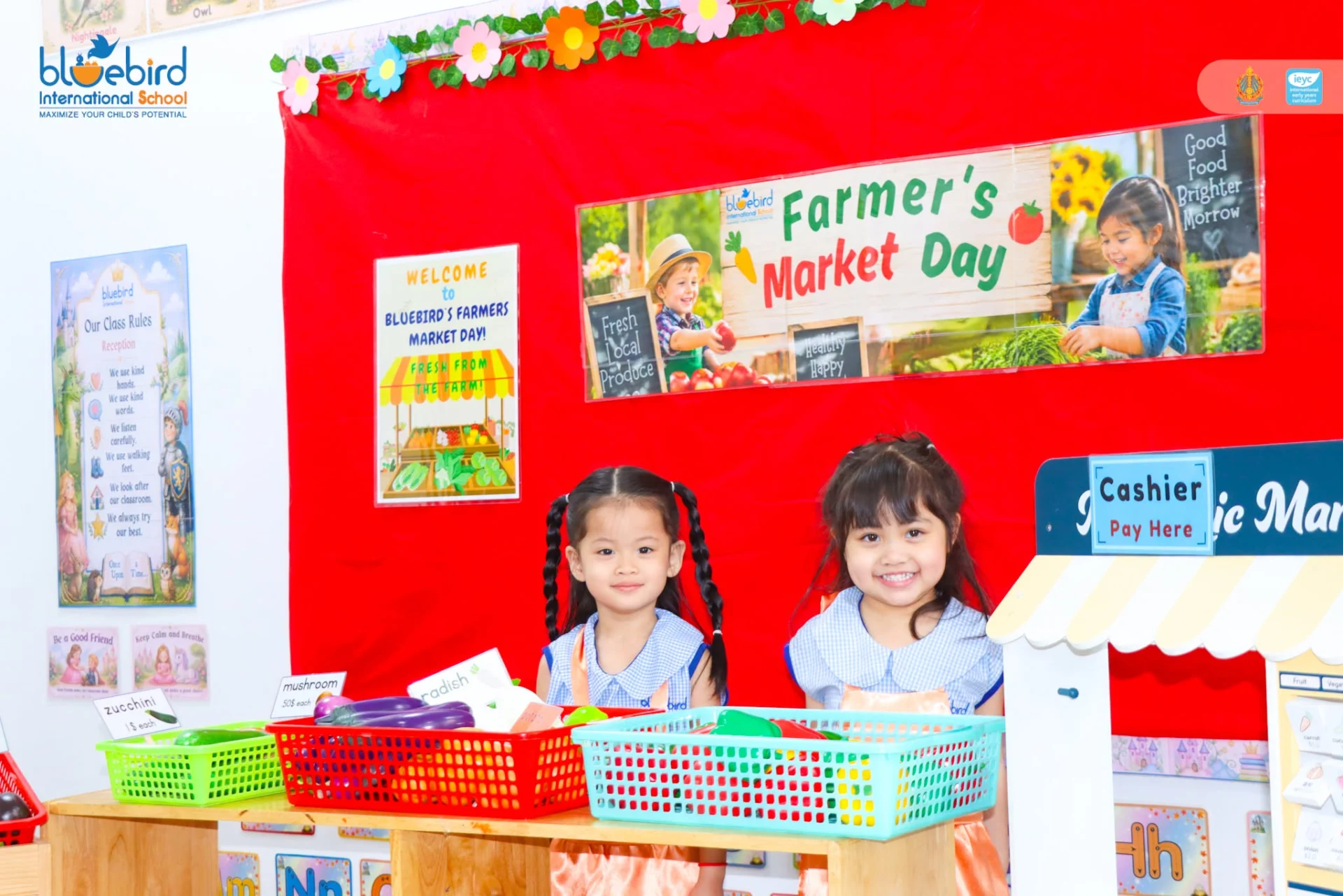

Bluebird International School has shared a classroom activity called the Red Robins Farmers’ Market, in which young children practised shopping and selling through play. The school’s Facebook post describes students taking on different roles, preparing fruit, handling pretend transactions and searching for bargains. The activity gave children a practical setting to explore communication, teamwork and early counting skills.
Bluebird International School holds Red Robins Farmers’ Market

The Red Robins class took part in a market-style learning experience organised around familiar everyday activities. According to the school, children acting as sellers cleaned and prepared fruit, while others served as cashiers or shoppers.
The school’s photographs show children standing behind colourful displays and using baskets of toy food. A classroom sign identifies the activity as Farmers’ Market Day. These images illustrate the play-based setting, while the post provides the details of the roles children practised.
Bluebird International School presented the activity as an opportunity for its youngest learners to develop practical skills in a supportive environment. It did not specify the children’s exact ages, whether real money was used or the length of the session.
How a pretend market supports early mathematics
A classroom market creates opportunities to practise early number concepts in a context children can understand. Young learners can count pieces of fruit, compare quantities, sort items into groups and match objects with numbers.
Cashier roles can introduce simple exchanges and the idea that items have prices. Teachers may adapt these tasks to children’s developmental levels, using pictures, tokens or play money where appropriate. The school’s announcement mentions counting but does not describe the precise materials used for transactions.
For children who are beginning to recognise numbers, handling objects can make an abstract concept more concrete. Repeating a counting task during play also gives teachers opportunities to observe which skills are becoming more independent.
Communication and social skills through role-play
Playing the roles of shopkeeper, cashier and customer invites children to use language for a purpose. They can practise asking for an item, responding to a request, greeting a visitor and taking turns in a conversation.
Children may also learn to negotiate simple choices, wait while someone else is served and cooperate when organising a shared stall. These are useful everyday skills that can be supported through guided play.
Not every child needs to participate in the same way. Teachers can provide visual prompts, model short phrases or offer alternative roles for learners who require additional support. The goal is meaningful participation appropriate to each child’s communication abilities.
Practical learning through food and everyday routines
The school’s post notes that sellers cleaned and prepared fruit. Such routines can introduce discussions about hygiene, food handling and responsibility. For younger children, tasks should be supervised and adjusted to avoid unsafe tools or choking hazards.
A market theme can also encourage observation and classification. Students may compare colours, shapes and sizes of different foods or discuss which fruits they recognise from home.
These activities connect classroom learning with experiences children may encounter when shopping with family members. Parents can extend the discussion by asking children to identify produce, count items or help organise a shopping list.
Learning through the Red Robins Farmers’ Market
Bluebird International School described the event as a lively experience involving sellers, cashiers and shoppers. Its announcement specifically identifies teamwork, communication, counting and real-life skills as areas practised during the activity.
The Bluebird International School Red Robins Farmers’ Market demonstrates how a familiar shopping scenario can provide structured opportunities for early learning. Through play, children can explore everyday responsibilities while building confidence in communication and basic mathematics.
If the information about this school is inaccurate or incomplete, Contact Us.
Would you like to register your school? Click Here.



Leave A Comment