
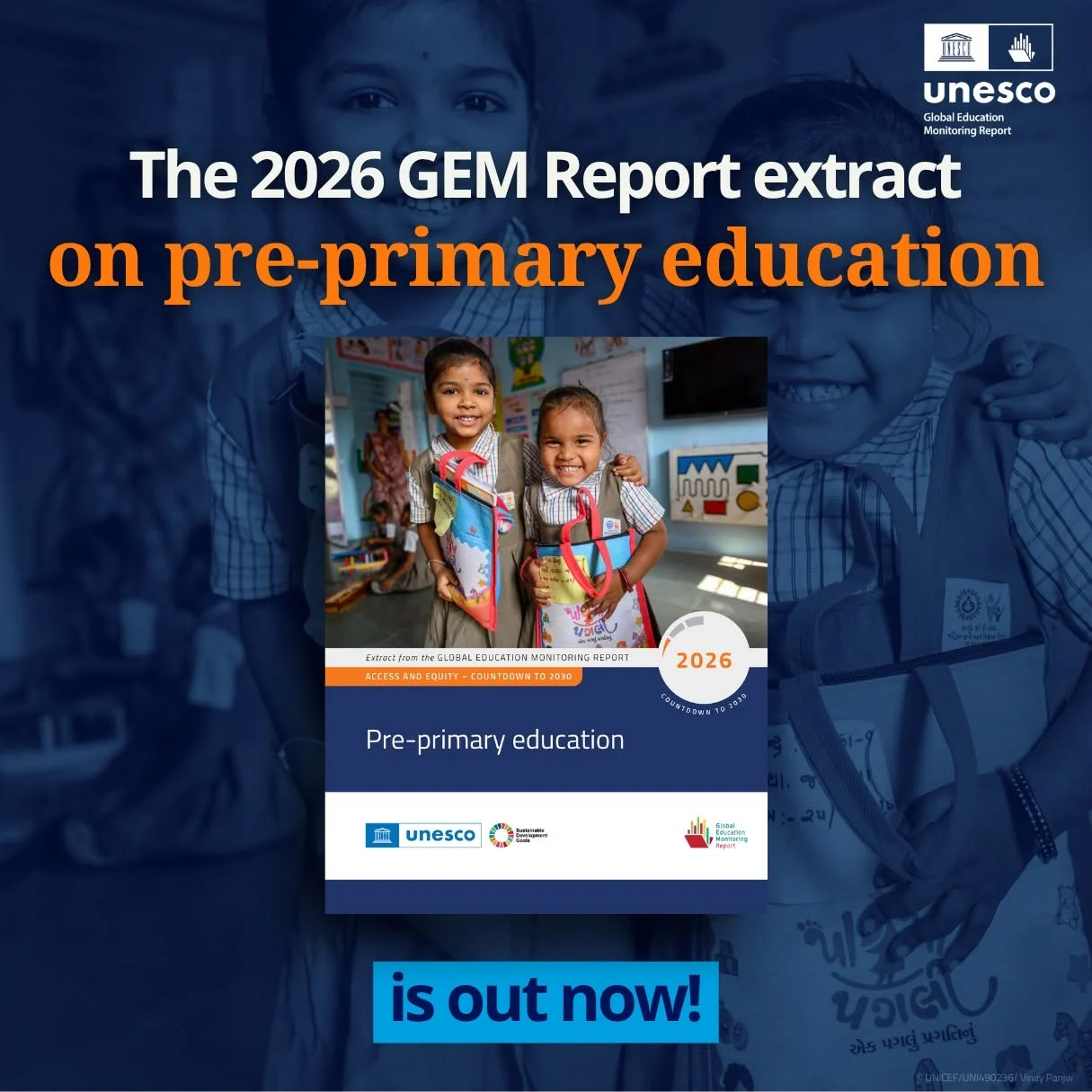
UNESCO’s 2026 Global Education Monitoring (GEM) Report extract on pre-primary education examines why access to early learning remains unequal around the world. According to a Facebook announcement from GEM Report UNESCO, only an estimated six in ten children globally have attended at least one year of pre-primary education. The organisation also warns that progress in expanding access has slowed.
What the 2026 GEM Report says about pre-primary education

The newly highlighted publication focuses on opportunities for children to learn before entering primary school. It considers how national averages can conceal differences between groups of children and why measuring enrolment alone may not reveal the full extent of unequal access.
The announcement identifies seven country case studies as part of the analysis. These examine the role of political commitment, public financing, legislation and different approaches to providing pre-primary education. The Facebook post does not identify all seven countries or publish detailed findings from each case, so conclusions about individual national systems would be premature.
The reported global figure is an estimate of children who have attended at least one year of pre-primary education. It should not be interpreted as a measure of learning quality or proof that all other children received no early learning at home or in their communities.
Why access to early childhood education matters
Pre-primary education can introduce children to structured play, communication, early literacy and numeracy activities before formal schooling. In well-supported settings, children also practise routines, independence and interaction with peers.
Access alone does not guarantee these experiences. The quality of teaching, safety of the environment, availability of suitable materials and responsiveness to children’s developmental needs all influence what a programme can offer. Policymakers therefore need to consider both participation and the conditions in which children learn.
Families may encounter different barriers to enrolment, including fees, transport, distance, limited places and a lack of accessible support. The relative importance of these barriers varies across communities. Understanding local circumstances is essential before choosing a policy response.
Financing and policy choices in pre-primary education
The UNESCO announcement points to public financing and legislation as important areas for examination. Governments can influence access through funding decisions, rules governing provision and the organisation of services. The effectiveness of any approach depends on how it is implemented and who can use it.
For example, expanding places may have limited impact if families cannot reach them or if staffing is insufficient. Similarly, removing fees may improve affordability but leave other obstacles unresolved. Monitoring participation across different communities can help identify where additional support is needed.
The seven case studies mentioned by GEM Report UNESCO may provide examples of how countries have approached these questions. Readers should consult the publication itself for its evidence, methods and country-specific recommendations.
What the findings mean for Cambodia
For educators and families in Cambodia, the global discussion offers questions worth considering locally: which children can access early learning, what makes programmes affordable and how can schools support children with different developmental needs?
The Facebook announcement does not provide Cambodia-specific enrolment statistics or identify Cambodia as one of the seven case studies. It would therefore be inaccurate to apply the global six-in-ten estimate directly to Cambodia.
UNESCO’s 2026 GEM Report extract on pre-primary education invites governments, educators and families to examine how early learning opportunities are distributed. Its emphasis on financing, legislation and equitable provision offers a framework for discussing access while keeping national circumstances and evidence in view.
If the information about this school is inaccurate or incomplete, Contact Us.
Would you like to register your school? Click Here.

Leave A Comment