
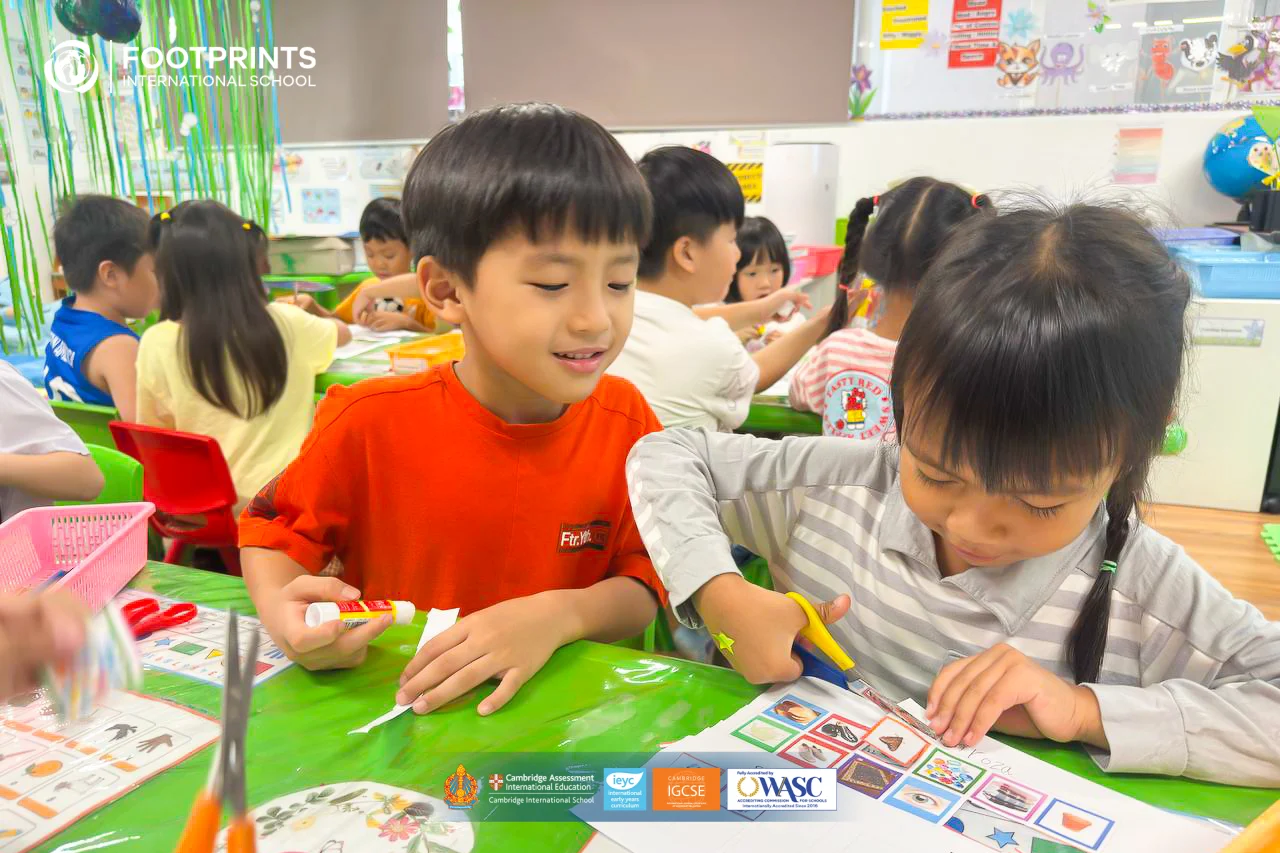
Exploring Science Through Hands-On Experiments at Footprints International School
Footprints International School continues to demonstrate how meaningful science education can be both engaging and practical for young learners. In a recent classroom activity, students explored the concept of reflective and non-reflective materials using simple tools such as a torch. This type of hands-on science learning allows children to understand scientific principles through direct observation and experimentation rather than passive memorization.

For many young learners, science becomes far more interesting when they are encouraged to test ideas themselves. Activities like these help students see how light interacts with different materials in the real world. By shining a torch on various objects, students were able to observe which materials reflected light and which absorbed it, turning a theoretical concept into an exciting discovery.
Understanding Reflective and Non-Reflective Materials
Learning about reflective and non-reflective materials is an important foundation in early science education. Reflective materials bounce light back, allowing us to see images or bright reflections. Common examples include mirrors, polished metal, and glass surfaces. Non-reflective materials, on the other hand, absorb or scatter light instead of reflecting it clearly.
In the classroom activity at Footprints International School, students experimented with different objects to observe how light behaved. By pointing a torch at surfaces such as paper, plastic, metal, and classroom objects, the children could visually compare the differences. These observations helped them understand why some materials appear shiny while others look dull.
Hands-on science activities like this encourage curiosity and critical thinking. Rather than simply hearing about scientific principles, students actively explore them. This approach helps children develop strong scientific reasoning skills, which are essential for deeper learning as they progress through their education.
Encouraging Curiosity Through Practical Learning
One of the key strengths of the activity highlighted by Footprints International School is its focus on experiential learning. When children are allowed to experiment, ask questions, and make predictions, they become more engaged in the learning process.
For example, students might ask questions such as:
-
Why does a mirror reflect light more clearly than paper?
-
Why do some surfaces appear shiny under the torch?
-
What happens when light hits a rough surface?
These questions naturally lead to deeper exploration. Teachers can guide students through discussions about light, reflection, and how these principles are used in everyday life. This method supports both scientific knowledge and communication skills, as students learn to explain their observations.
Building Early Scientific Thinking Skills
Activities that involve experimentation help students develop several important skills beyond basic science knowledge. When children test different materials and compare results, they begin to practice observation, comparison, and logical reasoning.
At Footprints International School, such lessons demonstrate the value of integrating interactive experiments into early education. Students learn not only about scientific concepts but also about the process of investigation. This approach prepares them for more advanced science topics later in their academic journey.
Early exposure to scientific exploration can also inspire long-term interest in STEM subjects. When students associate science with discovery and excitement, they are more likely to remain curious and motivated to learn.
The Importance of Engaging Science Lessons in International Schools
International schools in Phnom Penh increasingly recognize the importance of active learning environments. Rather than relying solely on textbooks, schools are integrating experiments, collaborative activities, and inquiry-based teaching methods.
The science activity conducted at Footprints International School reflects this modern educational approach. By encouraging students to explore reflective and non-reflective materials with a torch, teachers created a memorable learning experience that combines curiosity, observation, and discussion.
Experiences like these demonstrate how practical activities can make science both accessible and enjoyable for young learners. When students are encouraged to explore their environment, they develop confidence in asking questions and finding answers.
If the information about the school is not accurate and insufficient Contact us.
Do you want to register your school, Click Here.

Leave A Comment